
Archive | Short story RSS feed for this section

SPECIMEN & Other Stories

10 Sep

http://www.dreamstime.com/royalty-free-stock-photos-hand-butterfly-image1071848

SPECIMEN & Other Stories by ALAN ANNAND

A six-pack sampler of short fiction by Alan Annand:

Bananarama: Reformed meat-eater embarks on a 15-day bananas-and-orange-juice diet, with surprising side effects.

The Date Square Killer: Mild-mannered hit man finds love, social justice and the meaning of life in non-random acts of murder.

River Girl: Middle-aged bureaucrat takes a detour on his morning jog that leads him to an unexpected rendezvous with Fate.

Specimen: A wealthy butterfly collector visits his twin brother, warden of a penal colony, who is building his own unique collection.

The Bassman Cometh: My night with Margaret Atwood: Hapless university graduate student in 1975 ruins famous Canadian author’s poetry reading.

The Naskapi & the U-Boat: A German U-Boat in WW2 visits northern Quebec to install a weather station, but a native family compromises their secret mission.

Amazon: http://www.amazon.com/Specimen-Other-Stories-Alan-Annand-ebook/dp/B00THKBJ22

Apple: https://itunes.apple.com/us/book/specimen-other-stories/id966756381

Barnes&Noble: http://www.barnesandnoble.com/w/specimen-other-stories-alan-annand/1121209434

Kobo: https://store.kobobooks.com/en-CA/ebook/specimen-other-stories

Smashwords: https://www.smashwords.com/books/view/518775

What’s on your ebook?

26 Jun

AA-8books-1

ALAN ANNAND: Six mystery-thrillers, a story collection, and a book of astrological essays. 

Scorpios at night …

7 Apr

digging at nightI was digging a hole for a body the other night and I got to thinking, why does everyone seem to hate Scorpios? So I leaned on my shovel and asked my partner Sybil who was helping me dig, “Why does everyone hate us?”

“By us, you mean stone-cold killers?” she said.

“No, I mean Scorpios.”

“Oh, that again.”

We’d had this discussion before. By a twist of fate, we’d been thrown together seven years ago, having survived an attack of killer bees on a nature hike in Arizona. We’d both been stung dozens of times, and half our party had died of anaphylactic shock. But apparently we’d had good immune systems. After a couple of days in hospital, we were discharged.

tequila fireWe’d gone out for lunch and over drinks got to comparing life stories. Turns out we were both triple Scorpios – ascendant, sun and moon. Bad to the bone. We decided to buy a bottle of tequila, score some local weed and rent a motel. I could tell you the rest but that would just be pornographic.

“Seriously, why do they hate us?”

“From my point of view,” she said, “it’s because you never tell the truth. You’re sneaky. You’re always doing things behind my back.”

“Baby, I’m hurt. You know that’s not true.”

“Then you play the victim, just so you can manipulate me. You don’t play nice. You’re a sociopath.”

chameleon womanPlay nice? This coming from the Chameleon Queen?” I had to defend myself, because Scorpios never back down. “You blow hot and cold one minute to the next. You ask to be left alone, next thing you’re sexting some guy on the phone. I call you out, and you get all nasty with me.”

“You’re nosy. You’re always snooping around my business.”

“Monkey business isn’t a real occupation, except for you.”

“You’re sarcastic and mean.”

“I just tell the truth. Straight up. On the rocks, baby.”

“You have zero empathy for others. You could watch a person die and not lift a finger, unless it was to check their wallet or cop a feel.”

“I give everybody one chance, but one chance only. If you can’t stand on your own after I’ve helped you up, I’ve got no use for you.”

tequila shots“Except when you want to jump my bones.”

“I swear, it’s never even my idea. I think you got some little voodoo doll of me in your drawers, you take it out and start jerking it off. Next thing I know I’m lapping tequila shots out of your navel.”

“C’mon, admit it. You’ve got sex on the brain. I look at you, I see a 24/7 woodie.”

“Maybe so, but it’s not just for you.”

“Like I said, sneaky and mean.” She brought her shovel to her shoulder and I took a moment to gauge the radius of the handle and how far I’d have to jump if she took a swing at me. The hole we’d dug was almost big enough for two.

“Now baby, you know I’m just kidding.”

“That’s not kidding, that’s being passive-aggressive.” She turned her eyes on me. “Now look here.”

evil eyes“No.” I averted my gaze. “I don’t want to be hypnotized or X-rayed. There ought to be a law against your evil eye.”

“Huh. If I could really see through you, I’d get a glimpse of some reptile, all scaly and squinty-eyed from being underground so long he forgot how to be human.”

“I’ve got a right to my privacy.”

“You sleep in my bed, you have no rights and no secrets. You obey me. There are no safe words. You do not fuck with me unless invited.”

“Yes, ma’am.”

“And do not take a sarcastic tone with me.”

“Baby, I don’t want to fight. We’re just talking. I want to understand why they hate us so much.”

wet T-shirt“You really don’t know?”

“Do you?”

Sybil put down her shovel and took off her sweater, revealing only a thin T-shirt beneath. Because it was a warm night and she’d been working the shovel hard, the T-shirt was wet and clung to her breasts like a moist cheesecloth over freshly-kneaded loaves of bread.

She spread her sweater on the ground a few feet from the hole. “Come here and I’ll show you.”

coyote“Is this some kind of black magic thing, what with the full moon and a fresh corpse and all?”

“Shut up and get naked.”

A coyote or a wolf, something hungry, howled from not too far away. A chill went up my tailbone, but I didn’t run. Safety in numbers, even if we were only two. We were both triple Scorpios, after all, so we were practically a six-pack.

night couplingShe shucked off her jeans, stretched out on her sweater and writhed like a snake in the moonlight. I joined her there among the pine needles and we made love like wild things, scaring off all the animals in the forest.

Maybe that’s why they love to hate us.

~~~~~~~~~

Alan Annand is a writer and astrologer with the moon in Scorpio. Find his New Age Noir series and other mystery novels at Amazon, Apple, Barnes&Noble, Kobo and Smashwords.

Neil Gaiman (b. November 10): “You get ideas from being bored” & other quotes on writing

10 Nov
gaiman2

pinterest.com/pin/39406565465126680/

Neil Gaiman, born 10 November 1960, is an English author who writes short stories, novels, comic books, graphic novels and films. His novels include Stardust, American Gods, Coraline, and The Graveyard Book.

Quotes on writing

  1. Tomorrow may be hell, but today was a good writing day, and on the good writing days nothing else matters.
  2. Fairy tales are more than true: not because they tell us that dragons exist, but because they tell us that dragons can be beaten.
  3. You get ideas from daydreaming. You get ideas from being bored. You get ideas all the time. The only difference between writers and other people is we notice when we’re doing it.
  4. Fiction allows us to slide into these other heads, these other places, and look out through other eyes. And then in the tale we stop before we die, or we die vicariously and unharmed, and in the world beyond the tale we turn the page or close the book, and we resume our lives.
  5. Stories you read when you’re the right age never quite leave you. You may forget who wrote them or what the story was called. Sometimes you’ll forget precisely what happened, but if a story touches you it will stay with you, haunting the places in your mind that you rarely ever visit.

Yiyun Li (b. November 4): “One should be able to imagine being somebody else”

4 Nov
yiyun li, author

pinterest.com/pin/39406565465091654/

Yiyun Li, born 4 November 1972, is a Chinese American writer whose works include the short story collections A Thousand Years of Good Prayers, Gold Boy, Emerald Girl, and the novel The Vagrants

Quotes on writing:

  1. I think I’m just writing about human nature and it just so happens that my characters are Chinese.
  2. To write about a struggle amidst the struggling: one must hope that the muddling will end someday.
  3. What a long way it is from one life to another: yet why write if not for that distance; if things can be let go, every before replaced by an after.
  4. Oftentimes if a story didn’t work, I would rescue one character or two characters—or one paragraph—from the story and start all over. Which actually was very efficient for me, I think. You can spend so much time revising.
  5. When I first started writing, I thought a lot about the shape of the stories—do you have a triangle or a rectangle, or do you have a mirror image? Is one character a mirror image of the other? What variation did you do with the characters to make that interesting? 
  6. I wish people would ask me about the importance of the imagination. I really believe that one should be able to imagine being somebody else. This is important for writers, but it’s also important for readers, and for all human beings to be able to imagine being somebody else.

Cormac McCarthy (July 20): “I’m not interested in writing short stories.”

20 Jul

mccarthy

“I’m not interested in writing short stories. Anything that doesn’t take years of your life and drive you to suicide hardly seems worth doing.”

~ Cormac McCarthy, b. 20 July 1933

http://pinterest.com/pin/39406565462495759/

The Bassman Cometh

19 Nov

(My Night with Margaret Atwood)

Every once in a blue moon someone pops up like a demented jack-in-the-box to inflict such havoc in your life that they become elevated, for at least that short troubled time, to the status of nemesis. Briefly many years ago I had the dubious distinction of playing that role opposite none other than the reigning queen of Canadian literature, Margaret Atwood.

Nemesis. For those who lack a superlative command of Greek vocabulary, look it up in your Funk ’n’ Wagnall’s. A nemesis, from the Greek for “pain-in-the-ass”, is that worthy opponent who makes life hell for the hero(ine) and, in the downer ending that rarely cuts it in Hollywood these days, inflicts retribution or vengeance upon them. As Professor Tarzan might say, me Protagones, you Antagones, now let the drama begin.

In the fall of 1975 I was in a Master’s program at the University of New Brunswick. Thanks to respectable undergraduate marks and a handful of short stories and poems published in UNB’s literary quarterly The Fiddlehead, I’d been granted permission to write a creative thesis in lieu of an academic one.

Unfortunately this did not exempt me from taking two academic courses of incredible dryness. The only course of interest was one on Yeats, whose fascination for the occult resonated with me. But to fill out my program I was stuck taking a course on 19th Century Canadian poets, an academic field of such barren prospect (or so it seemed to my 26-year-old mind) that I feared to die of boredom.

Meanwhile, in lieu of writing a novella or a dozen short stories for my creative thesis, I was zealously pounding away at a porn novel, which a writer friend of mine had assured me was the easiest way to break into the New York publishing world. In a more-or-less continuous state of tumescence, I had little patience for Bliss Carman’s “I think that I shall never see / a poem lovely as a tree”, when what my daily page-count required was more of “He lifted her skirt and felt her plush buttocks yield to his probing fingers…” But I digress.

As a grad student I had an assistantship and a monthly stipend from the English Department to perform menial labor for an assigned professor. It was academic feudalism but it helped pay the bills and, until my porn novel breached the gates of the Big Apple smut kingdom, I was resigned to my fate. I was assigned to the Professor of Creative Writing who was responsible, along with teaching the usual academic load, for managing UNB’s Visiting Writers program. My role in the big scheme of things was to help him however he deemed suitable.

Thus far in the fall semester, I’d been obliged only to plaster the campus and a few select downtown locations with posters advertising the October visit of poet Al Purdy. Plus ensure there were two bottles of Scotch waiting in Purdy’s hotel room when he arrived. Purdy had been in great form the night of his reading, bellowing his poetry in a robust voice to a crowd of aficionados. After the reading a bunch of us trailed the literary force majeure back to the bar of the Beaverbrook Hotel, like a school of remora all wanting a ride on the shark. There Purdy commandeered a corner table and, flanked by a couple of blondes too old to be students, too provocatively dressed to be professors, and too many to be his wife, proceeded to drink everyone under the table.

In November the Professor placed all his trust in my faint abilities to be the “handler” for Margaret Atwood’s visit to UNB. A daunting and prestigious assignment! Aside from the poster campaign there were only a couple of other duties – arrange for a PA system the night of her reading, and pick Ms. Atwood up at the Fredericton airport. Unlike Purdy’s voice, conceivably strengthened in noisy bars drawing the attention of busy waiters, hers was apparently rather delicate, better suited for genteel salon discourse over tea and Peek Freans.

November passed quickly. Deeply immersed in my porn novel, I’d lost track of the date. Luckily, I remembered to get the posters up in time but neglected to deal with the PA system. The day before her reading I checked with the campus office that handled such things and was told that their only portable PA system had already been loaned out to another function. I called a downtown music store and learned I could rent a PA system for $50. I laid out the alternatives for the Professor’s executive approval – spend $50 on the PA rental, or at no cost, I could set up a microphone with my guitar amplifier. The Professor stroked his goatee, trying to dislodge some fleas he’d harbored there since the Cuban missile crisis, and said it was my call.

I tested my amplifier that night. It was a Fender Bassman tube amp that required a 10-minute warm-up before each performance. Its 100 watts were capable of driving two 15-inch speakers in a cabinet the size of a steamer trunk. I plugged in my bass guitar and gave it a fierce workout until the next-door neighbors started pounding on the walls. Philistines, they had little appreciation for the hypnotic bass riff of Iron Butterfly’s Inna Gadda Davida played over and over and over again. I plugged in my microphone, which I’d bought at Sears a few years ago for $19.95, and tested it. Aside from an annoying tendency to squeal like a butchered pig when I stood directly in front of the amp, it was good to go.
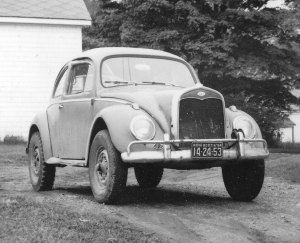
Friday morning it started snowing. I was driving a 1965 Volkswagen Bug at the time and like most students I had little money for automotive maintenance. The battery was in a fragile state and most nights I brought it to bed with me to keep it warm. The heating channels that ran from the rear engine to the front vents were rusted out, and on most winter days I had only a small space of clear window in the lower left corner of the windshield to see through. For a broader vista of the road ahead, I kept a scraper handy to clear the hoar-frost from the windshield.

But these were minor inconveniences compared to my clutch, which no longer worked. To start the car I needed to coast downhill or get a push. Once going I was able, with a skill equal to a Formula One race car driver, to shift gears, crunching and grinding as I expertly matched the engine revolutions to the transmission. Since the UNB campus was built atop a hill and I myself lived in a house whose driveway sloped to the street, gravity was on my side in most cases.

Just as nature abhors a vacuum, my VW feared the straight and level, and recently I’d declined to become involved with an attractive grad student of apparently relaxed morals simply on the grounds that she lived in an apartment complex situated in a gulag of flatness. However much I appreciated field work for my porn novel, I didn’t need the embarrassment my clutch-less car promised.

That afternoon I carried my battery out to the car, gave it a push down the driveway and headed off to the airport to fetch Margaret Atwood. En route I cleverly gauged the flow of traffic approaching intersections and managed to slow or speed up as the situation required, such that I never came to a dead stop and risked stalling my vehicle. At the airport I was relieved to see the parking lot built on a slight incline. Although snow was still falling, I figured that with a push I would become mobile again.

Inside the terminal I checked the flight schedule. Ms. Atwood’s plane had apparently just arrived. I wandered around the arrivals lounge, her face still fresh in my mind after all the posters I’d put up. But all along, I’d imagined I was looking for someone of considerable stature, as befitted the Queen of CanLit. Probably five foot nine or ten, I figured, she was that BIG. I kept looking, but nowhere did I see her. Finally, there was no one left in the arrivals lounge but me and this petite woman with curly hair, who finally came up to me and said, are you from UNB?

Ohmygod! The light went on with such a blinding flash that I must have stood there stunned for several seconds, immobilized like a moose on a dark highway when two drag-racing tractor trailers come tearing around Dead Moose Curve, bearing down on him…

She must have snapped her fingers. I yanked my consciousness back to the arrivals lounge and saw her standing there with her paisley suitcase, looking very impatient like she had somewhere to go in a hurry. Probably forgot to use the facilities on the plane, couldn’t go to the washroom when she arrived because she was afraid she’d miss her ride, and was now just plain anxious to get to the hotel. I offered to carry her bag but she wouldn’t let me touch it.

We went out to the parking lot where I explained the situation. I would put the car in neutral and we’d both push until it got a bit of a running start down the inclined parking lot. Then I’d jump in, hit the ignition and, God willing, the clutch-bone connected to the tranny-bone connected to the wheel-bone would turn at just the right speed to allow the engine to start with the stick-bone in first gear. She stared at me like I was kidding. She soon found out that wasn’t going to get her anywhere.

I had to give her credit, she was game. A lesser woman would have said, to hell with this backwoods horseshit, I’m taking a taxi into town and sticking UNB with the fare. But no, she was cool. She put her suitcase in the back seat of the car and pulled on her gloves like she really meant to get a grip on things. Now that’s a poet. You could tell just by the color of her gloves, red like boxing gloves, that she was a fighter and Governor General’s Award material to boot.

We got the Bug rolling in short order, and I was thinking we probably looked like the Wright Brothers trying to get the Kitty Hawk airborne. But when I jumped into the car, Ms. Atwood didn’t have the horsepower to continue its momentum. Before we ran out of incline, I hit the brakes and we changed sides. I’d push from the rear and she’d push at the driver’s side with one hand holding the door open and the other hand on the steering wheel. Off we went. When we were up to speed, I yelled at her to jump inside but she yelled back it was going too fast and she was scared, and I yelled back at her that she’d better, or we were walking to Fredericton, and she’d be late for her poetry reading.

At that, she jumped in, hit the ignition, and the engine caught. I ran to catch up with her. We couldn’t stop the car for fear of stalling the engine so I had to yank open the driver’s door and stand on the running board while she climbed over the gearshift into the passenger seat. As I slide behind the wheel I grabbed the gearshift to shove it into second gear. She gave a little yelp and I realized that I’d grabbed her knee because her dress was still caught on the gearshift and I couldn’t see, honest, what I was putting my hands on. She struggled to get her leg over and I heard a rip and then the gear dropped into fourth and we almost stalled before I could get my hand on the gearshift for real and pull it back into second where it belonged.

We didn’t talk much until we were downtown, coasting into the driveway of the Beaverbrook Hotel. Because I couldn’t really stop, not on a little incline like that, we had to circle through once and she opened the door and tossed out her carpetbag suitcase like a UNICEF plane doing a supply drop for some culturally-starved hamlet deep in the interior of Sticksville. Then we went around once more and she opened the door and perched on the passenger running board, her beret cocked over one eye like some French Resistance fighter parachuting behind enemy lines.

I asked her if she wanted me to come back and pick her up at seven to go to the Professor’s for dinner. She said no, rather tersely, and jumped. What a trooper. I slowed as much as I could but she hit the ground on her wrong foot, I think, and staggered several yards before she ran into a parked Lincoln Continental. I heard a curse, although I don’t know whether it was from her or the guy whose ride she’d plowed into.

I went back to my place and, by making a sharp U-turn on my snow-slick street, spun around in the road and shifted gears from first to reverse as I slid backwards up my inclined driveway. I cut the engine and went in to my bed-sit apartment where I had a joint and a beer to calm my nerves after that exciting encounter with the Queen of CanLit. I got my bass guitar out from under the bed and checked my amp. Sixteen bars of Inna Gadda Davidda later, I figured everything was fine. I plugged in my Sears microphone. Testing, testing, testing…

At seven o’clock I packed my gear into the Bug, got a running start down the driveway and cruised over to the Professor’s house. He lived on the side of the hill so, even though I had to park a block away, I was set for the next leg of the evening. I arrived at the Professor’s place to find him and the missus in a testy mood. His wife was a handsome woman with thick eyebrows and ample breasts and whenever I saw her I thought of James Joyce’s character Nora in Ulysses, an earth mother with a vibrant passion for life. She gave me a wet kiss when I arrived and asked me what I wanted to drink. Knowing I was now in genteel company, I accepted a glass of wine.

Ms. Atwood arrived ten minutes later. The Professor and his wife gushed over her, taking her coat and asking about her flight, and whether she found the Beaverbrook Hotel to her liking. Ms. Atwood wasn’t very forthcoming in the travelogue department, providing only monosyllabic responses, which I thought was kind of pathetic for a woman with her alleged command of the language. Maybe she was just saving her bon mots for her reading later tonight. As she entered the living room with a slight limp, she glanced my way and I thought I caught a glimpse of something malign there, as if she suspected I might have been regaling the Professor and his wife with tales of airport follies.

Ms. Atwood and I sat in the living room while the Professor and his wife alternated playing host/hostess while the other scurried off to the kitchen where some culinary crisis seemed to be brewing. The Professor had a senile golden retriever named Shaggy that, however much she seemed to discourage it, took quite a liking to Ms. Atwood. I had to admit, there was a poetic ring to it – Shaggy and Maggie.

In any event, Shaggy was well-named because every time you touched him, a huge mitt-full of his hair came away in your hand. In moments Ms. Atwood’s other ankle-length dress, a tartan thing of dark colors, was covered with mustard-colored hair. In short order she was sniffling and sneezing and trying to push Shaggy away. He misinterpreted this as rough-house play and came bounding back each time to paw her all over. The Professor eventually saw that Ms. Atwood, clearly more of a cat person, had had enough of this fun and banished Shaggy to the basement where we listened to him growl and howl for the rest of the evening.

Eventually whatever had been on fire in the kitchen was put out and we convened to the dinner table where Nora brought out a blackened dish of casserole with apologies that the Professor had read the recipe wrong to her and she’d cooked it at 450 instead of 350. He scowled and denied it, but to make up for whoever had allowed such a thing to happen, opened a bottle of the “good wine” for dinner. Nora dished out generous helpings of blackened casserole, what might have sounded appetizing on a Cajun menu, with side orders of over-cooked broccoli and under-cooked carrots. Finding no topic worthy of conversation, we all drank a toast to the brave men and women of Canadian letters, and wielded our utensils to attack dinner.

After a brief foray between the layers of her lasagna, Ms. Atwood muttered that her lasagna contained meat. The Professor laughed heartily at that, saying of course there’s meat, that’s how we make lasagna, what were you expecting – tofu? And there was this dead silence, relatively speaking, except for the low moan of a desolate dog down in the dungeon, and Ms. Atwood said, but I’m a vegetarian.

Well, you could have heard a participle drop. But secretly I was thrilled. After the logistical nightmare of transporting Ms. Atwood from airport to hotel in my clutch-less car, my ears had been burning all evening just thinking of the polysyllabic cuss words she must have invoked as she mended her torn dress, applied liniment to a strained muscle, or examined the bruise on her hip where she’d collided with a Lincoln. I was relieved to see that a little of the shit going through the fan would be spread liberally around. Nobody could accuse me of having dumped a burned meat offering on her plate.

We all looked at each other. The Professor was aghast. No one had told him. He’d read every word of Northrop Frye, he assured us, and not once had that esteemed critic of Canadian literature mentioned that Margaret Atwood was a vegetarian. She fixed him with a squinty eye and said in a frosty tone whose spirit flatly contradicted the words she chose, it’s all right, I’ll just eat around it.

For a moment there, I struggled to recall a joke that might lighten the atmosphere. But a glance at Ms. Atwood, seeing a bright spot on her cheekbone, cautioned me that this was a situation where belly laughs would not be readily forthcoming. So I bit my tongue, diplomat that I am, and chewed silently on my blackened lasagna leather.

Again I had to tip my hat to Ms. Atwood. She could have stood up, knocked over the table and stormed off into the wintry night to flag a taxi whose driver might have guided her to a Chinese restaurant with a nice bean curd soup and vegetarian spring roll to tide her over. But no, she hung tough. Using her utensils as deftly as a surgeon, she quickly dissected the lasagna, pushing the meat off to one side, the pasta off to another, and grimly ate her meal, her face reflecting the same gusto with which Russian soldiers during the Stalingrad siege controlled their gag reflex to swallow a rat drumstick and a side order of rotten potato.

The rest of us pretended not to notice how picky she was, when I know we were really all thinking, what the hell’s the matter with a bit of Grade A ground beef? The Professor opened another bottle of the “good wine” and deftly steered the conversation boat toward the shores of Canadian Literature, prattling on about how The Fiddlehead was publishing reams of good stuff this year, some of it contributed by very promising young writers, like Alan sitting right here at the table. Ms. Atwood turned her head a couple of degrees in my direction, and one of her eyes regarded me warily, reminding me of the way horses watch you nervously when you sneak up on them with the gelding shears.

Showing the first glimmer of sympathy I’d seen all evening, Ms. Atwood sought to relieve the Professor of his lasagna faux pas by asking him kindly, how fared dear old Fred Cogswell. This was another English Faculty professor of great geniality who had for many years offered a heavy load of “bird” courses in which every student, no matter how densely illiterate, stood assured of getting at least a B-grade, while he simultaneously shepherded to print the quarterly edition of UNB’s literary magazine, The Fiddlehead, whose literary output was second only to what was coming out of Kingston via The Queen’s Quarterly.

Well, given a nudge in the right direction, the Professor was off and running like a horse with the bit between his teeth. We got treated to a complete rundown on every other academic in the English Department. An ex-patriate American, the Professor had once mentioned in class that, instead of going to Korea, he’d served stateside in Military Intelligence, implying that he was pretty hot stuff, and that he’d been in a serious quandary at one point as to whether he should take a job with the CIA and become an assassin of Commie agents or continue his graduate studies to become a professor. Lucky for those Commies he’d made the wrong choice.

You could tell, however doubtful his story was, that there was indeed something of the spy in him, the way he’d built a dossier on the whole English Faculty, just in case Canada, as left-wing as it was, turned Commie too and he’d have to squeal on his associates in order to protect his own tenure.

Dessert was offered but Ms. Atwood, as anxious as any sane visitor to escape from a nut-house back into normal society, said maybe it was best to forego that pleasure and head off to the university for her reading. The Professor would drive her, she made that clear, so I headed off on my own. The Bug was parked on a steep street so it was a breeze to get started and drive over to UNB, whose campus itself was built on the summit of a considerable hill. I parked at the highest point I could find in the lot of the Memorial Hall Building, and made two trips to carry into the lecture hall my Fender Bassman amp with its huge speaker cabinet and the 100-watt amplifier head along with my Sears microphone and assorted cables.

The lecture hall, which the Drama Club used for its monthly productions, had a good-sized stage and mezzanine section, behind which a spectator gallery with built-in wooden seats rose at a steep incline. I imagined this was something like the design of old-style English theatres, where the gentry looked down over the heads of the riff-raff. Little did I know that a Shakespearean drama of minute proportions was about to unfold this evening, and that I would play such a villainous, albeit petty, role.

As the spectator gallery filled up, I went about my business as poet roadie. I plugged in my amp and cabled it up to the speaker cabinet. I ran the microphone cable up onto the stage where a wooden lectern faced the gallery. In those days, living on the shoestring of a graduate student’s assistantship, I’d never known the luxury of a microphone stand. During jam sessions in my apartment with my brother or some other amateur, I’d made do with a broomstick handle taped to a chair, and the microphone taped to the broomstick. Tonight in my haste I had forgotten to bring my broomstick.

But as Frank Zappa used to say, necessity is the motherfucker of invention, and I wasn’t going to let a little thing like this spoil Ms. Atwood’s big night in Fredericton. I hustled out to the cloak room where I found a wire coat hanger. I bent it into an appropriate shape and anchored one end of it around the lectern’s reading light and, with a generous quantity of electrical tape, secured the Sears microphone to the other end of the coat hanger. I switched on the amp and gave it a few minutes to warm up.

Although the Bassman was a classic piece of rock ’n’ roll equipment, practically a collector’s item, it was a tube amplifier. There were about half a dozen of those tubes, each one looking like a little miniature city under a dome of glass, the lights slowly coming on in the little cathode skyscrapers. Compared to today’s modern electronics, this was almost Soviet-era technology, but if it was good enough for Jimi Hendrix, I figured, it was good enough for Margaret Atwood.

In a few minutes, the Bassman was humming happily, a steady low-decibel drone like a distant airplane that could be heard throughout the lecture hall. I thought this might be a little distracting so I tried reversing the polarity on the power plug, but that only sent it into overdrive, like the sound of a kamikaze plane beginning its dive into some hapless troop ship. I quickly returned the plug to its earlier position.

By now the lecture hall was filled to capacity. Ms. Atwood was chatting with a few of the English Faculty and at one point I actually heard her laugh, and I could see that everyone was squirming with excitement and that the evening was shaping up to be one of those great cultural events everyone would fondly remember years after. A few minutes later the Professor started shushing people and urging them to take their seats. He and Ms. Atwood mounted the stage where he fumbled his way through her introduction, getting the name of one of her novels wrong, calling it The Inedible Woman, probably still thinking of the food she’d left on her plate. Finally, he finished and left the stage to her.

There was a hushed silence in which the audience was clearly perplexed to hear the drone of a distant airplane. I crept from my seat in the front row and thumped the Bassman with the heel of my hand. A low rumble echoed from the back of the hall. Now it sounded like an airplane flying through a thunderstorm. I passed my hand over the amplifier and discovered that if I kept it within a few inches of the biggest tube, the sound of the distant airplane diminished from that of a four-engine cargo plane to that of a single-engine Cessna. I crouched there, my hand in place like a Reiki master administering healing vibes to a sick client, and nodded to Ms. Atwood that it was safe to proceed.

She began to read her poetry. She had a small breathless voice like an asthmatic child and it was clearly evident why amplification was mandatory for her. Things went well for another poem or two and then it all went to hell in a handcart. She was in the middle of a poem when the Bassman suddenly cut loose with a terrible yowl, like a cat “getting fixed” without benefit of anesthesia. She stopped in mid-sentence and glanced in my direction, and the look in her eyes was like a hail of bullets in a drive-by shooting. I be wastin’ yo ass, muthahfuckah, if’n I hear dat again.

I withdrew to the side of the amplifier. On other occasions before this, I’d noticed that if you approached it too closely from the front, the amplifier would start to squeal with feedback. Jimi liked that sort of thing, but Maggie didn’t. I stroked the Bassman with my Reiki technique but it wouldn’t behave.

Up on stage, thinking maybe it was her end of things that had gone awry, Ms. Atwood tried to adjust the microphone at the end of the coat hanger. The electrical tape peeled off and the microphone fell with an amplified “thunk” to the lectern. I heard titters and sighs from the peanut gallery as I vaulted up onto the stage and went to her rescue. I wrapped the microphone back into place with some extra tape and hissed at her to stick to the poetry and leave the sound system to me, at which point I realized my harsh words were being amplified for all to hear. More titters and sympathetic groans of outrage from the gallery. I slunk back to my post beside the Bassman.

To reduce an epic story to a haiku, hell hath no fury like a feedback-prone amplifier. Maybe all those old Marconi tubes, even as they teetered on the verge of electronic Alzheimer’s, still harbored some kind of primordial intelligence like the computer Hal in the movie 2001. And in the heart of its circuits the Bassman probably suspected it’d been pressed into service, not to hasten the revolution via rock ’n’ roll, but to propagate mere poetry without the force of power chords and killer riffs.

No matter how I cajoled him, Bassman wouldn’t behave. He growled and howled, drowning out every word Ms. Atwood tried to share with her audience. I twirled his dials and flicked his switches, punched and kicked him, and rocked him back and forth. Bassman would not be controlled, so in the end he had to be silenced. I pulled the plug.

Ms. Atwood looked at me, as if to say, are we done now? I shrugged helplessly, feeling like the village idiot in a room full of professors, students and Faculty wives. In a less evolved society they probably would have brought out the tar and feathers for a brief intermission, but I was fortunate to have been born in genteel times, and was allowed to slink back to my seat without anyone throwing more than dirty looks my way.

The rest of the poetry reading was rather uncomfortable, like watching a blind person walk barefoot through a room littered with broken glass. Ms. Atwood, still the trooper in a situation that only electro-shock or several years of scream therapy would likely erase from her memory, soldiered on. She read her poetry just like they must have done in the old days, her naked voice against the crowd, while back in the upper reaches of the peanut gallery, people asked her to speak up, please, they couldn’t hear her. And she would say, I’m sorry but I’m speaking as loudly as I can, and then she would cough to clear her throat and in a thin reed-like voice, she would continue to read her poetry.

There was a lot of applause when it was over. Mostly relief, I felt, but there was admiration too, the kind we reserve for marathon runners who come straggling in at the end of the race, wobbling and half-blind with fatigue, garnering applause not because they have beat anyone’s time but because they have, against all apparent odds, finished the job they set out to do.

As the crowd evacuated the lecture hall, I dismantled my equipment and humped it out through a side door to the car, studiously avoiding the eyes of anyone who crossed my path. There was a wine and cheese reception in the salon down the hall in Ms. Atwood’s honor, and although I had played a significant part in making this a memorable evening, I humbly felt that it was not the place for me to make an appearance and draw any undue attention. I walked out to the Bug, released the hand brake and coasted out of the parking lot. Once I was safely out of earshot I switched on the ignition and descended into the wintry night, swallowed up in the bowels of my quiet provincial town.

For awhile on campus I was quite notorious for the role I’d played that night at the aptly-named Memorial Hall. Several of my crueler fellow graduate students, doubtlessly honing the skills with which they would later denigrate their associates in competing for tenure, took to calling me The Bassman. And each time this elicited raised eyebrows among fresh company, someone would tell the story of how I’d ruined Margaret Atwood’s poetry reading.

The irony was that they barely knew a fraction of the story, but I was in no mood to provide more hoist for my own petard. Eventually I tired of this teasing and, like a lion tormented by dogs, in one pivotal week around the time of the Winter Solstice, announced my withdrawal from graduate school and burned the manuscript of my porn novel in a desolate section of the New Brunswick backwoods.

Since then, I’ve had many occasions to reflect upon my freshman-like approach to graduate-level responsibilities those many years ago. Still, it’s spilled milk under the bridge, and no amount of groveling would suffice to earn Ms. Atwood’s forgiveness. To broach the subject with her now, even via an abject letter of apology, might precipitate a flashback, the magnitude of which could plunge her into who knows what state of psychological imbalance. Worse still, she might write vilifying letters to the Canada Council and every publisher she knows, nipping in the bud any hopes I might have had to forge my own literary career. No, if I’ve learned one thing after all these years, it’s best to fly under the radar.

~~~ The End ~~~

Bananarama (humor)

31 Jan

Many years ago, inspired by the stellar example of the Buddha, and a bizarre association with one Wild Bill Periwinkle, an American New Age writer I’d met in the backwoods of New Brunswick, I decided to become a vegetarian.

It was a sensible thing to do, although desperation played a part. After years of struggling to make it as a writer, I was ready to emulate the virtues of any good role model, and since Wild Bill had already carved a niche for himself in the publishing world, I figured that if it worked for him, it might also work for me. According to Wild Bill, if only I’d free my body from the bad karma of all those hapless animals sacrificed for my dining pleasure, my luck would turn, and I too could soon see my name on a book jacket. Equally important, Wild Bill explained, there were also significant health benefits.

“After years of eating meat, the heavy mucus coating in the colon thickens to the consistency of truck tire rubber, becoming a host of putrefaction. As noxious debris seeps through the bowel wall, the capillaries to the colon suck up these toxins and distribute them freely among the organs and tissues of the body.”

Wild Bill took a long draw on a skinny joint and passed it to me. He was a normally reticent fellow, but as soon as he had a lungful of ganja smoke inside him, he became as gabby as a talk-show host on amphetamines.

“Thanks to years of encrusted fecal buildup, some colons under autopsy have measured nine inches in diameter, with channels no bigger than a pencil through which one can barely pass a rabbit pellet, never mind the super-sized leftovers of yesterday’s fast food meal. I’ll bet you didn’t know, Elvis had 60 pounds of this crap jamming up his exit route.”

“Is that why he died on the john?” I said.

“To rid your body of all that intestinal gunk, and pave the way for a better life, both now and in your next incarnation, you’ve got to undergo a cleansing diet,” Wild Bill told me in his most seriously spiritual tone.

It seemed like a worthy goal, and although I’d followed Wild Bill’s advice on any number of other quasi-mystical regimens that had failed to manifest any noteworthy benefit, I was always game for another adventure in consciousness-raising. According to Wild Bill, it was simply a matter of faith and perseverance before my colon would be running as clean as a mountain stream.

The program was deceptively simple, as outlined in The Canadian Whole Earth Almanac, a copy of which Wild Bill loaned me as proof this wasn’t just another of his crazy ideas, but was in fact endorsed by one of the flagship publications of the counter-culture. In the best New Age tradition, with a strong bias for all things cosmic, the diet would start on the New Moon and finish on the Full Moon. Fifteen days, in which I should eat no more nor less than nine bananas a day. To wash it down, I could drink all the orange juice I wanted. And if I needed to suppress any gas resulting from the consumption of enough bananas to feed a small tribe of monkeys, I should add three cardamom seeds to this daily regimen. That’s it, that’s all.

This being my first diet, I decided to keep it simple. I’d never been one to suffer from gas, so I didn’t trouble myself with hunting down the exotic cardamom seed at a natural foods emporium. Instead, I went to the nearest supermarket and bought a case of almost-ripe bananas, and a gallon of orange juice. The checkout girl looked at me kind of funny.

“Do you have a pet monkey?”

“Yes, but he’s a naughty little primate, and I frequently have to spank him. Do you love animals? Maybe you could help. What time do you get off work?”

She hurriedly gave me change and turned her attention to the next shopper in line. I shouldered my case of bananas and headed home.

My first day went something like this: two bananas for breakfast, three bananas for lunch, three bananas for dinner and one banana for a late-night snack. The first couple of days went fine. I liked bananas and they seemed to like me. I noticed, however, that despite all this volume, my bowels seemed to have gone on strike. Maybe they were just trying to adjust to this pH-neutral food that was so good for them that they didn’t know how to deal with it, somewhat like the aboriginal peoples who didn’t get it at first that the arriving colonists would, contrary to all the initial evidence, eventually improve their quality of life, turning them from itinerant hunter-gatherers into business-savvy casino operators.

Finally, on day three I had a bowel movement that should have prompted me to get a photo and/or a witness to register it for the Guinness Book of World Records. It was the size of a banana-colored anaconda, and took several flushes of the toilet to banish it to the netherworld of the sewage system. My inner monkey got quite a primal fright in seeing this snake-like phenomenon so up close and personal, but after it was gone, I felt distinctly lighter in all respects. Maybe I was now on my way to cleanliness of body, soul and spirit, just as Wild Bill in a temporary lucid state had prophesied.

Around day five, I began to suffer gas attacks the like of which World War One trench soldiers had never experienced. At first it was just a minor thing, a bit of intestinal bloating, followed by a relieving wind that smelled distinctly of bananas. It had quite a sweetish odor, actually, and in the volumes being emitted, quickly precluded the need in my apartment for incense to mask the odor of stale kitty litter or the catnip my feline friends were fond of smoking day and night.

I rushed out to the nearest health food store and bought a hundred grams of cardamom seeds. I didn’t have anything with which to grind the seeds to a powder, so I just gobbled a handful. An hour later, I lay doubled up on my bed, nearly paralyzed by terrible stomach cramps.

Meanwhile, it was obvious that the cardamom seeds had none of their desired effect, and by day’s end I was discharging gas almost continuously, at an industrial rate of production. My lower bowel had been transformed into a banana methane factory.

I called my girlfriend and cancelled our usual Friday night date. She was miffed but I preferred not to explain. On Saturday night I skipped a movie I’d planned to see with some buddies. I didn’t go to church on Sunday morning. I missed classes on Monday, Tuesday, Wednesday and Thursday. On Friday, however, I had a test in American Lit 409 that was so important I couldn’t avoid it, so by hissing wind all the way to the class, and then completing a multiple choice questionnaire in record time, I made a beeline to the washroom where I cut loose a wicked one that nearly blew the door off the stalls. Temporarily deflated, I retreated to self-imposed solitary confinement in my apartment. Ironically, my reading assignment for the weekend was Gone With the Wind.

Whatever doesn’t kill us makes us stronger, Nietzsche said, but he never had to go through this. Suffering in the name of a good cause, however, I maintained a stiff upper lip and a flaccid sphincter. Four more days and my colon would be ollie-ollie-toxin-free. Although I desperately craved pizza, beer, potato chips, pork rinds, salted peanuts – anything but the sweet mush of another banana – I hung tough. God in his wisdom had something good for me at the end of all this, I believed, my faith as unshakeable as those Kamikaze pilots who rode their planes down to destruction with what they called a divine wind at their backs. Trouble is, when I looked over my shoulder, the wind at my back was nothing short of diabolic.

The hiss of gas was a constant background noise. My upstairs neighbors called the utility company to complain about a leak. When a technician arrived with his gas monitor, I told him to go ahead and check the place, I was just going out for a walk. I hurried across the street and into a cemetery where I hunched behind a gravestone and liberated some bowel steam. Squirrels in the trees above swooned like canaries and hung from the branches with sick expressions on their furry little mugs. When I returned to my apartment half an hour later I found a note from the utility man saying everything was fine with the gas lines, but maybe I should empty my garbage can, which was overflowing with rotten banana skins and empty orange juice cartons.

On the afternoon of day 15, the Full Moon, I was down to the short strokes on this inhuman diet, which by now I was convinced must have been dreamed up by Hanuman, the fierce monkey god of Hindu cosmology, as some bizarre rite of evolutionary progress. No dessert until you eat your vegetables, and no rebirth until you eat your fruit. I was counting, if not the hours, then certainly the bananas. 131 down, only four more to go. I could do it. Before me lay only dinner and a bedtime snack, and then one last night’s restless sleep, during which I would toss and turn and billow the bed sheets with enough banana methane to heat a house.

The doorbell rang. It was Wild Bill, come to town for his once-a-week grocery run, during which he invariably dropped his wife off at the local health food store while he popped around the corner to shoot the breeze and share a joint with me. As was his custom, it was already dangling from his mouth, his lighter cocked in his right hand ready for ignition. As he ambled in, he said, “Whew, that’s some funky-smelling shit, man, you need to open a window and vent this place out.” But before I could say, wait, don’t light that up in here, he flicked his lighter and a tiny flame erupted in a fiery cloud of gas.

They said the blast was heard a dozen blocks away. A fire truck was there in minutes, followed shortly thereafter by a hazardous materials unit and an ambulance, and later by the police and the arson squad. Wild Bill and I were released from the hospital that evening, after criminal intentions had been ruled out, suffering only minor burns incurred at ground-zero of what the haz-mat team called a low-concentration methane explosion of organic origins. I returned to my apartment, whose broken windows had been temporarily sealed with sheets of plastic. I opened two of the windows to create a cross-draught and set a place for dinner at the kitchen table. I pureed one banana in the blender to make soup, ate two more normally as the main dish, and diced the last one to eat for dessert. Exhausted but full, I went to bed.

Aside from the diabolic wind, I slept well, and on awakening to the smell of rotten banana skins, I emptied the garbage and swore that occult vegetarian diets would no longer be a part of this writer’s lifestyle. From this day forth, I resolved to revert to my omnivorous ways. With the dawning of a new day and a new lease on life, I hastened off to my favorite breakfast joint and ordered one of everything on the menu – eggs, bacon, sausage, ham, grits, beans, cereal, muffin, hash browns, toast, and a big pot of coffee.

Recognizing a ravenous man when she saw one, the waitress asked me, “Do you want a fruit cup with that?”

After a moment’s hesitation I said, “Yes, but hold the bananas.”


The Date Square Killer (short crime fiction)

28 Aug

Ken liked to relax at the Mercury Café. No one there knew he was a killer. He could drop in for a coffee and a date square and sit in one of their dumpy club chairs and read the newspaper. No one would be talking business – explaining to him their beef with someone, and asking him how much it’d cost to have their beef turned into hamburger.

It was a slack day and he had time on his hands. He took out his mechanical pencil. It was a beautiful red Pentel he’d taken from an accountant who’d borrowed far more cocaine money than he’d budgeted for. He worked on a Sudoku puzzle. It was a beginner’s level because he wasn’t that good with numbers and if he got frustrated and started to hear the voices of his grade school math teacher echoing in his head, terrible things could happen.

As he worked on his puzzle, he nibbled on a date square. He patronized the Mercury Café because of their perfect date squares. If she weren’t dead, he could have believed his mother had made them. They had just the right amount of date filling, husk-free and not too sweet. They stuck together perfectly, so he could hold one in his free hand and eat it until it was gone and it wouldn’t fall apart on him. Some of these other places, you needed a whisk broom to finish the damn things.

He was sitting in his favorite chair in the back corner when a couple came in. The guy was maybe 21, 22, but looked like he’d got stuck in high school mode and couldn’t squirm out of it. He had a skateboard in one hand and a can of Red Bull in the other, tats up and down his arms and calves, wearing a T-shirt and a pair of those ridiculous baggy pants that came down to just below the knee.

There was a girl with him, she looked maybe 19 but stretching for a few years beyond, like she couldn’t wait to graduate from being a girl and turn into a beautiful young woman. She wore a sleeveless white cotton summer dress, briefly translucent as she was framed in the sunny entrance, and had a thick tangle of blonde hair that obscured her face.

They stood at the counter while the guy ordered a couple of coffees from the barrista. It was the end of the afternoon and the place was pretty busy so the good seats in the front half of the café were already taken. After they cased the joint and came to the same conclusion, they walked into the back and sat on the old sofa that was next to him.

The guy propped his skateboard against the sofa and put his feet on the coffee table. The girl sat beside him, but closer to Ken, keeping her knees together and smoothing her dress around her thighs as she settled in. Her tanned legs were the color of coffee ice cream. She carefully removed the lid from her takeout cup, took a brief sip and grimaced at the heat. She blew on the surface of the coffee and Ken noticed how pretty her lips were, pursed like that, as if she were blowing a kiss.

“Are you coming to Mom’s birthday party?” she asked the guy with her.

“I dunno. I want to go to a party in Oakville.”

“That skank you met on Facebook?” she said.

Annoying rap music erupted from somewhere inside the guy’s pants. He pulled out a cell phone and said, “Whazzup, bro?”

It turned into a long conversation, something about a girl that the caller had a hardon for, but it was apparently going nowhere fast…

Ken knew the feeling. Women didn’t dig him. It was like they had a sixth sense, they looked at his hands and knew he’d done so many bad things with them, and they couldn’t stand the thought of him touching them, and they ran away as fast he appeared on their horizon. He could write a book about unrequited love.

“Are you finished with that section of the paper?” the girl asked him.

Ken looked at her. She was looking at him. Her eyes were like emeralds with lights behind them. He was blinded, like a raccoon in the middle of the road, and a Jaguar bearing down on him. Whump. That was the sound of her tires running over his heart.

“Uh, yeah. Help yourself.”

She took the newspaper, the Entertainment section, and began to read the cover story.

Ken looked at the numbers on the Sudoku grid and couldn’t make sense of anything. His mind was like one of those paperweights that had been shaken, little snowflakes cascading down upon a landscape vaguely familiar and strange, hiding his tracks so that he wasn’t sure how he’d actually got here or how he was going to get home again.

The guy was still talking on the phone. Ken couldn’t believe how rude he was, ignoring the girl beside him. He understood from their three-line dialogue they were probably brother and sister, not boyfriend and girlfriend, but still. People with cell phones didn’t deserve to have friends, or family for that matter, if they were going to behave so badly.

Some days when Ken was in a bad mood he made lists of people he would kill for free. People who abused and abandoned their pets. Drivers who didn’t signal their turns. People who tossed litter on the sidewalks. Owners of very expensive cars who always seemed to have handicapped placards on their dashboards, but not a handicap in sight.

He looked at her again and wracked his brain for something to say. Her beauty was a frightening hurdle, like a mountain in the distance that he wanted to climb but knew that he would run out of oxygen and die before he reached its peak.

She turned the page in the newspaper, picked up her coffee, sipped it again, and her eyes drifted briefly his way.

“Would you like a date square?” he said to her, regretting it immediately. Could he have picked anything more ridiculous to say?

She looked at him and after a moment a crooked little smile appeared on her lips. “Who you calling a square?”

It took him a few seconds before he got it. Word play. She was messing with him. He liked that. His heart started pounding like a big bass drum.

“You’d never make it as a square,” he said. “Too many curves.”

“The better to roll with the punches,” she said.

“Anyone punched you,” he said, “I’d tear their arms off and club them to death with the stumps.”

“Ooh, that’s the nicest thing anyone’s said to me all day.”

“Did I…? Oh, I’m sorry. I thought I was only thinking it. Sometimes things slip out.”

“Yes, I know. It’s like that motherfucking Tourette’s Syndrome. Don’t you just hate when that happens?”

“Don’t get me started. There are so many things to hate.”

“You know what pisses me off?” she said. “Take a walk along Avenue Road, see how so many handicapped people seem to drive a BMW, a Mercedes or a Porsche. I’d like to line up the doctors who signed those permits and run over their legs with a bulldozer.”

Ken couldn’t believe his ears. It was both shocking and exciting to hear someone who thought so much like him. He stood up, but he wasn’t sure whether he should walk or run away. The last time he’d expressed an attraction for a woman, she’d called 911.

“Would you like something? Date square, chocolate brownie, macadamia nut cookie…?”

“What? I thought you were asking me for a date. Now who’s square?”

He stared down at her. Was she still messing with him? This was worse than Sudoku. The numbers didn’t add up. She was beautiful and innocent, and he was a beast with homicidal hands. What kind of children would they have?

Ken looked from her to the other end of the sofa, where the guy was now curled up like a pretzel, still on the phone. “I wouldn’t have said something like that, not when you’re with someone.”

She made a dismissive wave. “My idiot brother?” She looked at her watch. “We were supposed to catch up, on account of we haven’t seen each other, for like a month, but he’s been on the phone all this time and now my break’s over and I’ve got to get back to work.”

“Where’s that?”

“The Gap on the next block.”

She stood up, made the universal thumb-and-pinkie signal to her brother. Call me, asshole. And walked out.

Ken followed her into the sunlight. Briefly, it was like something out of a movie, where the earthlings step out of the spaceship and the new world is all bright and shiny and marvelous and they know somehow everything’s going to be all right.

He saw it too late to warn her. Some idiot had left a juice bottle lying on the second step. She slipped on it and would have taken a header onto the sidewalk if Ken hadn’t reached out with reptilian reflex and grabbed her bicep in his hand. He held her steady until she was on the sidewalk.

“Oh my God, your hands are so amazingly strong.” She looked up at him with gratitude. “And warm.”

“Thank you.”

“You can let go now.”

“Sorry.” His mother had always said, you find what you want in life, you hold onto it tight and never let it go. He wondered about that sometimes, and why she hadn’t held onto her own life, instead of spiraling down the drain in a swirl of cheap wine.

“I’ve got to get back to work.” She pointed down the street.

“What’s your name?”

“Barb.”

“I’m Ken.”

“Barbie and Ken.” She smiled. “My friends are going to rip me a new one over that.”

It took him a few moments before he got it. Was she making fun of him? He looked at her, still standing there, smiling with teeth from a dental ad, waiting for him to say something clever…

“What time do you get off work?”

“Six.”

“Would you like to go to dinner with me?”

“Only if you’ve got a lot of money, because I am really hungry. Not to mention, thirsty.”

“I have money.” It had been a good month. He’d killed two guys and he had another one to do this afternoon, although he wouldn’t get paid until tomorrow.

“If you’ve got the money, honey, I got the time.”

Ken had to control himself from having a nostalgic meltdown right then and there. His mother used to sing that song when he was a kid, and waltz him off his feet around the kitchen in their shitty little two-bedroom apartment, until he got too big for her and she got too drunk to dance.

Ken looked at his watch. “How about if I meet you right back here when you get off work?”

“Deal.” She offered her hand.

Reluctantly, he shook hands with her, feeling her little palm swallowed up inside his big paw. Her hand was very warm and slightly moist, like a burrito that had just come out of the microwave.

“Okay, I’ll see you later.”

“You know, maybe I shouldn’t say this,” she said, “but you have awesome hands. They give me the shivers, you know, in a nice way.”

“I get that a lot,” he lied, and he knew by the way she laughed that she knew he was full of it and she didn’t care. She waved bye and headed off toward the Gap.

He turned and walked away. He gritted his teeth, telling himself not to get all mushy and look back at her. He started to hum a tune to himself, observing the debate going on between his ears. There was the old Ken who insisted she’d stand him up and he’d never see her again, and there was the new Ken who believed he’d see her for dinner tonight, and then who knows what could happen…

He walked back to his car, a 14-year-old white Volvo – solid, dependable and unremarkable, very much like himself. He got inside and drove across town to Danforth Avenue where he parked on Logan in the heart of Greektown. It was wall-to-wall restaurants and bars and cafés for half a dozen blocks along this stretch. It was a warm and sunny September afternoon and there were lots of people on the terraces. He found the restaurant he wanted and went inside and saw the guy sitting there with a couple of friends. He was wearing a yellow shirt that stuck out like a banana in a haystack. Perfect.

Ken checked his watch and walked back to his car. He knew the guy had to be somewhere else at five o’clock, and he’d have to leave soon. But if Ken had his way, he wouldn’t get far.

He got back inside his Volvo and opened the glove compartment to take out a pair of flesh-colored latex gloves. He pulled them on and then reached under his seat to take out the gun. It was a .22-caliber Comanche revolver with a 9-shot magazine. They were pretty cheap and he bought them by the six-pack for a discount. The originals had 6-inch barrels but he’d taken a hacksaw to all of them and cut two inches off the muzzles. All the work he did was close up and personal, and he didn’t need a gunsight to hit a frontal lobe.

He got out of the car and slipped on the double-breasted blue blazer with the gold buttons that he kept in the car for his work. He looked around to make sure no one was looking and stuck the gun into his waistband. He took a pair of sunglasses from the dash and slipped them on.

He opened the back door and picked up a soda can from the floor. He’d stuffed it lightly full of cat hair that he’d accumulated from weekly brushings of his 12-year-old Angora cat, whose name was Boston Blackie. The rate at which Blackie was shedding was sufficient to handle about three hits a month, and since Ken rarely achieved such a level of business, he had a bale of hair at home, enough to stuff a couple of pillows or knit a few sweaters.

He locked the car and headed back to the Danforth, occasionally raising the soda can to his lips and pretending to take a sip from it, but all he got was a whiff of pussy hair. Typical. Sometimes a whiff, rarely a taste. But all that could change…

He glanced at himself in the window of a storefront. Lookin’ sharp, man, like a car salesman in a recession, all dressed up and no place to go. A couple of songs danced through his head, competing for his attention. He’s a real nowhere man, working with his awesome hands… And those bearded Texas bluesmen, singing Everybody talkin’ ‘bout a sharp-dressed man…

He was a hundred feet away from the restaurant when the banana shirt stepped out onto the sidewalk. That was one thing Ken had, it was a sense of timing, like he was right in lockstep with destiny. He followed Mr. Banana a dozen stores down the street, and stood looking in the window of a bookstore until the guy re-emerged from a convenience store. Mr. Banana tore the cellophane off a pack of cigarettes, ripped out the foil-wrap sleeve and lit a cigarette with a lighter. He crumpled the waste in his fist and threw it half-heartedly at a trash bin, totally missing the waste paper aperture, and the garbage fell onto the sidewalk.

Ken gritted his teeth, picked up the litter and placed it in the Paper & Plastic compartment. It wasn’t much, but it was the principle of the thing. What was the matter with people these days?

He followed the guy around the corner onto Carlaw. A dark blue Porsche Cayenne was illegally parked in a commercial zone. Its lights blinked, its horn made a little toot, and its engine started up as Mr. Banana approached it. Ken crossed the street with him, glancing around him as he went. No innocent bystanders to witness what was about to happen, the nearest pedestrians on Danforth a good twenty yards away.

Mr. Banana opened the door and slipped behind the wheel. Ken was just five steps behind him. He saw it was a Cayenne Turbo, which listed for about $125K. Interestingly enough, there was a big blue Handicapped placard lying on the front dash. Oooh, bonus points!

He caught the door just before Mr. Banana swung it shut and in one smooth movement he pulled the Comanche from under his jacket, jammed its barrel into the mouth of the soda can and popped the guy one right under the armpit. The home-made silencer burped discreetly. The guy leaned away from him, pawing the air like he was trying to shoo away a bumblebee, and his voice gagged in his throat, like the noise Blackie made when he was trying to cough up a hairball. Ken grabbed the flapping hand, held it tight for a moment, and popped the guy another one right in the temple.

There was no big splat from an exit wound because a .22 didn’t have the power to do more than one cranial wall. The slug just went in and bounced around once or twice and that was all she wrote. The Cayenne’s cream leather interior would be left unspoiled and the wife could either keep the ride or, if she felt any guilt about it, sell it like new.

“Now you’ve got a real handicap,” Ken told the dead guy.

He kept the soda can but dropped the gun on the floor and closed the door. He looked around. Not a soul was looking in his direction. He’d always been lucky that way too. He walked back to Danforth and headed for his car. He stopped at one of the litter bins and inserted the soda can into the compartment marked Cans and Bottles. He peeled off the latex gloves as he walked along the sidewalk, glancing at the happy couples eating pikilia and drinking wine.

There was a small square at the corner of Danforth and Logan dedicated to Alexander the Great. Ken put the gloves in the Garbage compartment of another litter bin. A place for everything, and everything in its place, his mother used to say. Just that he’d never understood why she had to go so soon to the place most people tried to avoid.

He unlocked the Volvo, took off his jacket and laid it flat in the back seat. He was hungry and there was a souvlaki joint right there on the square, but it was already after five, and he didn’t want to spoil his appetite.

As he headed back downtown, he ran through a short list in his mind of places where he could take Barb for dinner. But mostly, he wondered what he’d tell her when she asked him what he did for a living.

– The End ‑

————————————————————————————————-

Did you like this short story? Want to try something longer, with a whole lot more action? Read some of the reviews for my novel Harm’s Way:

“For Canadian writers setting hard-boiled stories in Canada, the closest thing yet to a US-style private eye is Montreal investigator Lee Harms in Harm’s Way by Alan Annand.” – David Skene-Melvin in Rara-Avis

Harm’s Way is a solid P.I. thriller, a nastier-than-you’d-expect slab of pornography, cocaine, gangsters, incest, madness, torture and vengeance.” – Thrilling Detective

“Energy, superior punch-‘em out sequences, and humor.” – Kirkus Reviews

“Underneath the New Age trappings, divorced ex-cop Harms is plenty hard-boiled, using fists, guns and sheer wit to escape the many tight spots here.” – Publisher’s Weekly

Harm’s Way

A private investigator searches for the runaway daughter of an aspiring politician only to find that, on or off the campaign trail, honesty is the rarest commodity. As mystery descends into mayhem and murder, he confronts an unsettling truth – the innocents are always the first victims.

Kindle: www.amazon.com/Harms-Way-ebook/dp/B005LVXIA2

Other: www.smashwords.com/books/view/86740


Specimen (short crime fiction)

11 Jun

The island appeared in the distance, a smear of tan and green between the dark blue sea and the pale blue sky. It looked to be only a dozen miles in length, lying very low on the horizon as if hoping to escape notice.

Peter Flutterman in a white cotton suit and a straw hat stood on the foredeck, one hand gripping the deck railing as the boat crept up on the island. At his feet were a large suitcase, two portfolio-sized briefcases and a tubular case that looked as though it might contain a fishing rod.

*   *   *

As the boat approached the landing, a man came down to the end of the dock. He was wearing faded blue pants and a white shirt whose tails hung loose from his belt. A pith helmet sat low on his forehead. He looked to be in his mid-forties, the same age as Peter, although it was hard to judge with a full beard covering so much of his face. In any event, he looked well-preserved, unlike the typical islanders weathered by sun and wind.

The boat bumped up against the dock. A deckhand slung a rope that slithered snake-like across the dock. The bearded man picked it up and wrapped it around a capstan. As soon as the boat was secured, the deckhands formed a line and began transferring a series of boxes, barrels and bales from the hold to the dock. From the cabin, the captain waved silently to the bearded man, lighted his pipe and shook out a newspaper to read.

Peter picked up his tubular case and stepped over the gunwale. The bearded man reached out a hand to steady him as he stepped onto the dock. One of the deckhands added his suitcase and briefcases to the chain of dock-bound items.

The bearded man embraced Peter. “It’s been a long time, brother.”

“Walter? Is it really you, with a beard like a pirate?” Peter shook his head in wonder.

“And what about you, with cheeks like a baby’s bottom?” Walter touched the back of his hand to Peter’s face.

Peter tried to conceal his embarrassment. He wasn’t used to being hugged and touched, even by his long-lost twin brother. “Where’s your staff? We need help with this luggage.”

“We’ll manage all right by ourselves.” Walter picked up Peter’s two briefcases, leaving his heavy suitcase where it lay.

“I’ll need that,” Peter said.

“My staff will fetch it when they bring up the load of provisions. Let’s go up to the house and get you settled in.”

*   *   *

They walked up a footpath towards a large house framed by palm trees. Beyond the house was a quadrangle formed by long sheds. As they approached the house, a butterfly gyrated across their path. Peter dropped his case and chased it with his hat but it rose into the air and fluttered into the trees. Peter donned his hat in dismay, feeling foolish he’d been so overcome by excitement that he hadn’t extracted his butterfly net from its case.

“You needn’t have bothered,” Walter said. “You’ll see dozens more when we go into the jungle. You’ll catch them two at a time.”

“I don’t believe it.”

“Of course you do. It’s the only reason you came.”

“I’d have come anyway. It’s been too long since we’ve seen each other.”

“I’ve been writing you for years. First time I mention butterflies, you decide to come.”

“Oh, let’s not start arguing. I’ve barely arrived and we’re at each other’s throats again.”

“Right. There’ll be time for that later. You’re staying the week, aren’t you?”

“Hardly any choice, is there? Given the frequency of your supply boat.”

*   *   *

After dinner, the night came upon them suddenly, like a heavy curtain at the end of a scene. They sat in rattan chairs on either side of a big sturdy table. Dirty dishes were pushed to one side. A bottle of whiskey sat on the table, a drink within each man’s reach. Through the open window, a three-quarter moon was visible. Walter smoked a hand-rolled cigarette.

“Still got that filthy habit, I see,” Peter said.

“I’ve got a lot of filthy habits.”

“Whatever your faults, you’re a decent cook. I can’t believe you made this whole meal yourself.”

“I enjoy cooking.”

“I can’t imagine doing it all the time, though. Especially not in this heat.”

“Usually I have a woman do it.”

“A woman?”

“Lovely brown-skinned thing, about 20 years old. Taiana.”

“So where is she?”

“Vanished.”

“Beg your pardon?”

“Ran off. They do that, you know. They get tired of working and they just disappear.”

“But you’re on an island. She can’t just disappear. She must be out there in the jungle somewhere.”

“She’ll be back after a week or so.”

“This happens often?”

“Once a month, with great regularity.”

Peter helped himself to more whiskey. He took a sip and cleared his throat. “I don’t know whether this is the right time or not, but I think it needs saying. I hope there’re no hard feelings between us.”

“How do you mean?”

“After the will and everything. I mean, it wasn’t my idea that Father left everything to me. You were the one who decided you couldn’t stick around to work the business.”

“Thick-headed old bugger, he would never take my advice anyway. It was like working for a dictator.” Walter stubbed his cigarette in a saucer.

“I’m sorry I brought it up.”

“No, it’s all right. I don’t hold you any grudges. I went my own way, and you stayed at home. How he disposed of the estate was his business.”

“I was afraid you’d still be bitter. To tell you the truth, I was a little worried about coming here alone.”

“I’ve found peace in what I do.”

“Hard to imagine, living out here in the middle of nowhere, in charge of forty hardened criminals.”

“It has its rewards.”

“Really? What are they?”

“You’ll see – later in the week.”

“I never really liked surprises.”

Walter nodded. “I know.”

An old clock atop a cabinet in the living room began striking twelve. Peter noticed the tones had no sustain to them, as if they were muffled slightly.

Peter yawned. “I ought to pack it in. It’s been a very long day.”

“I’ll see you to your room.”

*   *   *

They entered a small bedroom containing a single bed, a clothes dresser and a small bedside table. Walter carried a lantern, which threw barred shadows on the walls. A canopy of mosquito netting lay draped over the bed. Walter set the lantern down on the bedside table and opened the window.

“I keep the windows open for the fresh air. The drawback is the mosquitoes, but the net will protect you.”

“I’ll be fine,” Peter said.

Walter opened the drawer of the bedside table and took out a revolver. He spun the cylinder and set the gun atop the table.

“What’s that for?” Peter said.

“Snakes. Prisoners. Taiana.”

“Snakes?”

“Boa constrictors. Sometimes they come into the house, looking for mice.”

Peter scanned the corners of the room. “Prisoners?”

“This is a penal colony,” Walter reminded him.

“And Taiana?”

“This is her room.”

“Really?”

Walter went to the door. “Good night. Pleasant dreams.”

*   *   *

They sat at the breakfast table. Walter was finishing off a fairly large fish. Another fish, complete with head, lay untouched on Peter’s plate. He toyed with a piece of toast.

“No appetite?” Walter gave him a glance. “Did you sleep all right?”

“Not really. I had a nightmare.”

“Probably shouldn’t have eaten so much of that goat cheese last night.”

“A woman came into my room last night, wearing only a grass skirt.”

“Couldn’t have been Taiana. She never wears anything after midnight.”

“She sat on the edge of my bed and put her fingers on my lips,” Peter said. “She told me I was in great danger.”

“You would be, if you ever let Taiana into bed with you.”

“She told me you had gone insane.”

Walter snorted. “She’s a fine one to judge. Once every month she runs off into the bush and lives in a tree.”

“She said that, every full moon, you go insane and kill somebody.”

Walter clucked his tongue. “Quite a dream.”

“It seemed so real.”

Walter shook his head with amusement. “Look outside. That is reality. The jungle waits for us. Beautiful butterflies. What do you want to do, get out there and add them to your collection, or sit here and relive some cheesy nightmare?”

*   *   *

Peter, carrying a basket and a butterfly net, walked with Walter, who had a small rucksack slung over his shoulder. They passed through the prison compound, a square courtyard bounded on three sides by long low sheds, and on the fourth side by a wall. The doors of the sheds were closed, the windows shuttered.

“Where are all your prisoners?” Peter asked.

“They’ll be gone all week. My guards took them to the other end of the island, harvesting pineapples. I didn’t think you’d want to have them around while you’re here.”

“Still, I was curious.”

“If you really wanted, we could hike to the other end of the island to see them. But it’s fifteen miles – a full day’s journey. We’d have to camp overnight and come back the next day.”

“Sounds like an adventure.”

“Wait and see how you fare today. This might be as much adventure as you can handle.”

*   *   *

Peter followed Walter along a jungle trail. The trail was barely visible. Now and again Walter swung his machete to clear away vines and undergrowth.

“Aren’t we close yet?” Peter said. “We’ve been walking for two hours.”

“You want prize specimens, you’ve got to get off the beaten path.”

“Frankly, I can’t see a path at all.”

They emerged into a large clearing on a hillside. At the upper end of the clearing was a 20-foot cliff separating them from higher ground above. In the middle of the clearing was a huge stone head similar in size to those on Easter Island.

Peter stared in amazement. “What is that?”

“Piece of local art.”

“It looks like me, without my glasses.”

“It’s me – before I grew my beard.”

“The natives regard you as a god?”

“It was done by one of my prisoners.”

“Why’d he make you look so sinister?”

“Artistic license, I suppose. But then, the prisoner never loves his jailer.”

Walter walked to the base of the cliff, where the sun cast a deep shadow, and slung his rucksack from shoulder to ground. He stuck his machete in the ground and removed his pith helmet to wipe his face on his sleeve. Peter, still staring at the stone head, followed him into the shade.

“So this is it,” Walter said.

“What?”

“Your hunting ground. Take a look around.”

Peter set his basket down and began to walk along the perimeter, where many flowers grew. Suddenly the air was filled with a cloud of butterflies. Peter pursued them with his net, capturing several in a few swipes. He came back to where Walter was now seated on the ground, his back against the face of the cliff.

“Didn’t I tell you?” Walter said. “Two at a time.”

“This is amazing.”

Peter opened his basket and took out half a dozen small jars. One was filled with cotton, another with fluid, the rest empty. He opened the jars, took a cotton ball and dipped it into the fluid, then put the ball in an empty jar. Carefully he plucked a butterfly from the net, examined it and then put it into the jar with the cotton ball.

“Ether?” Walter guessed.

“Chloroform.”

Peter plucked another butterfly from the net, examined it and tossed it away. It fluttered away across the clearing. He plucked out another one and put it in a jar.

*   *   *

Walter sat at the base of the cliff, reading a book. A bottle protruded from the top of his open rucksack. Peter trudged in from the sun and collapsed on the ground beside him.

“Anything interesting?”

Peter caught his breath. “Three new families.”

With obvious weariness, he prepared the last three jars. He poked around in the net, mauling the undesirables, and withdrew one by one the best three specimens of the catch. He placed each in its jar and put all his jars into his basket.

“What a day!” he rejoiced.

Walter offered Peter his bottle. “Celebrate. Have a drink. You’ve earned it.”

Peter hesitated, then took the bottle and drank.

*   *   *

Walter stood in the middle of the clearing, facing the stone head. Their expressions were equally grim. Walter dropped his cigarette on the ground and crushed it under his foot. He walked to the base of the cliff, where Peter lay curled, sleeping on the ground. Walter picked up the machete. He looked down at Peter, at the carotid artery pulsing in his exposed neck. Walter ran his finger along the edge of the machete. Peter snorted in his sleep, his legs twitching. Walter moved in closer until he was standing directly over Peter.

“Peter,” he called.

Peter woke up and raised his head. He saw Walter looming over him with the machete. His face convulsed in alarm. “No!”

“Yes,” Walter said. “It’s time to go. It’ll be dark by the time we get back.”

Peter lay frozen a moment, then scrambled to his feet. He gathered up his hat, his basket and his net. “How long was I asleep?”

“An hour or so.”

“What were you doing?”

“Getting hungry. Are you ready to go?”

*   *   *

Peter sat alone at the dining table. He removed the last specimen from its jar and with a long pin mounted the butterfly with the others on a panel of his portfolio case. He sat back and admired them.

Walter came in from the kitchen, carrying a platter of meat, a bowl of vegetables and a few plates balanced on his arms like a waiter.

“Aren’t they beautiful?” Peter said.

Walter nudged the portfolio cases aside and set down their food. “Yes, but more so when they were alive.”

*   *   *

Six nights later, they sat in rattan chairs on the verandah. A pair of glasses and a bottle of whiskey occupied the small table between them. Walter smoked a cigarette. A full moon hung well above the horizon. The water was dead calm.

“I can’t believe the week’s gone already. “Peter shook his head. “Tomorrow the boat comes to take me back.”

“Pity, isn’t it? We barely got to know each other.”

“I know. We’re still awkward – like strangers.”

“And there are still so many things I don’t know about you.”

“Like what?”

“I don’t know anything about your personal life.”

“I have none. I told you I never married.”

“But with no heirs, then what would happen if…?”

“Everything goes to the Royal Society.”

“Really?”

“Science is my only passion. I want to help support their research. I suppose you might think that’s unfair.”

“Not at all,” Walter shrugged. “As I said the night you arrived, I’ve made peace with my life. I don’t need your money.”

Peter squirmed a little in his seat and cast a suspicious look at Walter. He reached for the whiskey bottle and refilled his glass. Walter lighted another cigarette.

“And the business,” Walter asked, “does it take up much of your time?”

“Not really. Two foremen handle everything in the factory. An accountant takes care of the books, the bank transactions…”

“A business that runs itself,” Walter mused.

“That’s right. I have almost complete freedom to devote to my studies and researches.”

“Admirable.”

The clock in the living room began striking twelve.

“Good heavens, midnight already. No wonder I feel half dead. It’s time I retired. What about you?”

“I don’t usually go to bed until after one,” Walter said.

Peter stood. “Then I’ll see you in the morning.”

“Pleasant dreams.”

*   *   *

Peter lay snoring in bed. The door opened softly and Walter entered with a jar in one hand and a small towel in the other. He sat gingerly on the edge of Peter’s bed and parted the mosquito netting. He opened the jar and poured some liquid onto the towel. Averting his face, he gently placed the cloth against Peter’s nose and mouth. Peter snorted and raised a hand. Abruptly his hand fell back down to the bed and he heaved a deep sigh. Walter remained motionless at his side, the towel still on Peter’s face.

When Peter awoke, he discovered himself bound by wrists and ankles to a wooden frame propped against the wall of a shed. His surroundings were dimly lit by a lantern hung from a beam. Peter looked around and saw the vague outlines of several large whitish objects propped against the opposite wall. He sniffed the air and made a disgusted face. He struggled against his bonds but couldn’t budge.

Succumbing to panic, he screamed, “Walter! Help!”

Another lantern approached from the far end of the shed. It was Walter, with one hand behind his back. He hung the lantern on another beam. Peter looked beyond Walter and now, in the improved light, saw the lime-caked hulks of several dead men on wooden frames propped against the wall opposite, each with a wooden stake in his chest.

Peter fought to find a voice in his dry mouth. “Walter. Those men…”

“My prisoners, my specimens… As are you.”

Walter brought his hand from behind his back, revealing a heavy mallet and a wooden stake. He took the stake in his free hand and placed its sharpened tip against Peter’s chest. He raised the mallet over his head.

Peter screamed to no avail. “Please, no…”

*   *   *

Walter shaved off his beard and rinsed the soap from his face. He toweled himself dry and ran his hands over his smooth cheeks. He picked Peter’s glasses off the sideboard and put them on. He regarded himself in the mirror. Lovely. He looked just like Peter.

*   *   *

Walter stood on the dock, wearing Peter’s white cotton suit and straw hat. The supply boat bumped up alongside the dock. The deckhands unloaded a couple of crates and carried Peter’s suitcase, portfolio cases and net case aboard. Walter stepped onto the boat.

“Good morning, sir,” the captain greeted him.

“And to you, Captain.”

Have a good vacation?”

“Yes, thank you.”

“Your brother’s not here to see you off?”

“He’s busy at the moment, tracking down an escaped prisoner. But we said our goodbyes already.”

“Right, then. Let’s be on our way.” The captain called to his deckhands. “Cast off, there.”

Walter strolled back to the stern as the boat pulled away from the dock. He stood there a long while, looking back as the island slowly receded in the distance. He picked up one of the portfolio cases, placed it on a deck hatch and opened it. Dozens of pinned butterflies lay arrayed in neat order within the case. He pulled the pin from a butterfly and placed it in the palm of his hand. He tossed it up into the breeze and watched as it appeared to flutter away towards the distant island. He pulled the pin from another butterfly and did the same. And another, and another, as the distant island sank into the horizon.

– The End ‑

If you liked this short story, try one of Alan Annand’s novels:

SCORPIO RISING 

Kindle: www.amazon.com/Scorpio-Rising-ebook/dp/B0050IOY6I

All other formats: www.smashwords.com/books/view/59231

HIDE IN PLAIN SIGHT 

Kindle: www.amazon.com/Hide-in-Plain-Sight-ebook/dp/B0050K1EZA

All other formats: www.smashwords.com/books/view/59291

HARM’S WAY

Kindle: www.amazon.com/Harms-Way-ebook/dp/B005LVXIA2

All other formats: www.smashwords.com/books/view/86740