Archive | Writing RSS feed for this section

Evelyn Waugh (b. October 28): “An artist must be a reactionary” & other quotes on writing

28 Oct

waughEvelyn Waugh (born 28 October 1903, died 10 April 1966) was an English author, born into a family of publishers and writers. Waugh’s first book, A Life of Dante Gabriel Rossetti, was published in 1928. Soon afterwards his first novel, Decline and Fall, appeared and his career was sensationally launched. Evelyn Waugh wrote 15 novels and several acclaimed travel books, two additional biographies, and an autobiography, A Little Learning

Quotes on writing:

  1. I put words down and push them around a bit.
  2. There are no poetic ideas, only poetic utterances.
  3. Some people think in pictures, some in ideas. I think entirely in words. 
  4. One forgets words as one forgets names. One’s vocabulary needs constant fertilizing or it will die.
  5. An artist must be a reactionary. He has to stand out against the tenor of the age and not go flopping along.
  6. Only when one has lost all curiosity about the future has one reached the age to write an autobiography.
  7. Sometimes, I feel the past and the future pressing so hard on either side that there’s no room for the present at all.
  8. I should like to bury something precious in every place where I’ve been happy and then, when I’m old and ugly and miserable, I could come back and dig it up and remember.
  9. I used to have a rule when I reviewed books as a young man: never to give an unfavorable notice to a book I hadn’t read. I find even this simple rule is flagrantly broken now. 
  10. Don’t analyse yourself. Give the relevant facts and let your readers make their own judgments. Stick to your story. It is not the most important subject in history but it is one about which you are uniquely qualified to speak.

Jonathan Stroud (b. October 27): “Try different kinds of writing” & other quotes

27 Oct
stroud

pinterest.com/pin/39406565465045134/

Jonathan Stroud, born 27 October 1970, is an author of fantasy books, mainly for children and young adults. He is best known for the Bartimaeus Trilogy.

Quotes on writing:

  1. Practise: Write as much and as often as possible.
  2. Read: As above, as much and as widely as you can.
  3. Experiment: Try as many different kinds of writing as you can.
  4. When I write something that would have made me laugh as a 10-year-old, or would have scared me or would have excited me, I know I’m onto something.
  5. When I was young, I kept a diary for about 10 years and I had to write in it every day. Even on days when nothing seemed to happen, I made myself think of something to put in it.
  6. The important thing about any book is that you have to have a good story and that it has to be exciting. Then it’s nice to add other levels underneath that people can pick up on.
  7. As an author, you need to keep talking to your audience to remind yourself what they like and what they don’t like. You spend most of your life locked in a room, and you need to be social occasionally.

Marina Lewycka (b. October 12): “Comedy can expose the soul” & other quotes on writing

12 Oct
Lewycka

pinterest.com/pin/39406565464953383/

Marina Lewycka, born 12 October 1946, is a British novelist of Ukrainian origin. Her debut novel A Short History of Tractors in Ukrainian was long-listed for the 2005 Man Booker Prize and short-listed for the 2005 Orange Prize for Fiction.

Six quotes on writing:

  1. One of the nice things about being a writer is that no one recognizes you. 
  2. I’m a huge fan of Chaucer, he has the most wonderful characters, and I drew on him a lot for Two Caravans.
  3. My preferred place to write is in bed propped up with lots of cushions, and a nice pot of tea on a tray – but it can be hard on the back.
  4. I like to learn something as I write. I often start out with a subject I don’t know very much about and finding out more makes the process more interesting. 
  5. You think comedy isn’t serious, but with comedy you can say such a lot that serious can’t. Comedy can expose the depths of the soul; funny is what we are when we least intend to be.
  6. You must have a good story and find the right voice to tell it. Another useful tip is show, don’t tell. In other words, don’t write that a character behaved badly, show us their bad behavior instead.

“Al-Quebeca” ripped from tomorrow’s headlines

9 Oct

Ebook Al Quebeca v4darker charcoal thumbFor years nothing happens. Then everything happens at once. This applies both to writing novels and launching terror strikes.

For the record, I’m a writer, not a terrorist, although I admit to a fascination with the latter. As a Canadian, I’ve watched terror events unfold across the world with frightening speed and consequences. These events usually occur at a distance, allowing Canadians to be mere spectators rather than forced participants. But sometimes, things happen right in our backyard.

In 1999 the LAX bomber, Ahmed Ressam, was intercepted in Port Angeles, WA, with a carload of explosives destined for the LA airport. He’d entered Canada in 1994 with a forged French passport and lived in Montreal for almost five years, surviving by stealing airport luggage. After a trip to Afghanistan where he learned how to build bombs, the RCMP began following him, and alerted US authorities when he crossed the border from Vancouver en route to Los Angeles.

In 2006, the Canadian Security Intelligence Service (CSIS) arrested a group of jihadists, the Toronto 18, as they took delivery of three tonnes of ammonium nitrate with which they’d planned to build massive bombs in U-Haul trailers. Their targets: the Toronto Stock Exchange, the CSIS offices in downtown Toronto, and a military base. After the bombs, they would storm Parliament, seize the Cabinet and behead the Prime Minister, all in time for the evening news and instant fame via al-Jazeera. But the Toronto 18 had been infiltrated and monitored for over a year by 700 security officers gathering evidence via 80,000 electronic intercepts.

skull-bomb@50%In April 2013, following hard on the heels of the Boston Marathon bombings, two men with alleged al-Qaeda connections were arrested in Canada for plotting to derail a Canadian train travelling from Toronto to New York. Turns out there may have been an Iranian connection, wherein financial or technical aid was provided on behalf of al-Qaeda.

Apparently, news of that domestic terrorist plot raised only tepid interest from the US media, while the Twitter-verse responded with several jokes on the subject. Understandably, a neutralized threat in Canada pales in comparison to exploding bombs in Boston, but seriously, folks… Just because Canadians are liberal and polite doesn’t mean our society is any less liable than America’s in unwittingly harboring terrorists in our midst. Quite the contrary.

I wrote the first draft of my novel Al-Quebeca in 2009 and revised it several times over subsequent years. Each time it all seems even more inevitable. The plot involves an al-Qaeda sleeper cell in Montreal summoned to life by order of a Paris-based mullah. Although Osama bin Laden is dead and gone, he’d issued a fatwa several years ago, vowing revenge against any country, Canada included, that had sided with America in the Iraq and Afghanistan wars.

In Al-Quebeca, the Montreal terrorist plot involves a simultaneous three-pronged strike: to sabotage the Hydro-Quebec electrical grid that supplies power to Boston and New York, behead the visiting Governor of New York and, for body-count bonus points, kill thousands of hockey fans with nerve gas.

Preposterous? Not really. For years the CIA has warned CSIS that Montreal, where almost one in four residents is Muslim or has ties to Arabic-speaking homelands, is a hot-bed of al-Qaeda sleeper cells awaiting the call to jihad. We all think it could never happen here. Until it does.

guns_in_the_sky(Currently, in a case of life mirroring art, the radical jihadist group ISIS is encouraging independent acts of terrorism in every western country that participates in the US-led coalition against their brutal insurrection in Iraq and Syria.)

In Al-Quebeca, the heroine Sophie Gillette is a Montreal homicide detective dispatched in the middle of a snowstorm to investigate the suspicious hit-and-run death of an Iranian engineer who worked for Hydro-Quebec. Defying easy resolution, the case launches her on a collision course with biker wars, arms smuggling and, unexpectedly, a terrorist plot.

In the course of her investigation, Gillette uncovers militant students at Concordia University, drug financiers and a rogue professor with a PhD in chemical toxicology. All are linked to a shadowy figure called al-Quebeca whom Gillette must track to a brutal confrontation.

I just hate to be prescient, but as Aldous Huxley once said, The trouble with fiction is that it makes too much sense.

But don’t take my word for it. Read Al-Quebeca and judge for yourself.

You can purchase it at Amazon, Apple, Barnes&Noble, Kobo or Smashwords.


Belva Plain (b. October 9): “Read the best there is and thereby learn.”

9 Oct
plain1

pinterest.com/pin/39406565464936917/

Belva Plain (9 October 1915 – 12 October 2010) was an American author. Over 30 million copies of her novels were printed in 22 languages. 21 of her novels appeared on the New York Times best-seller list.

Six quotes about writing:

  1. I’m an early riser, and morning is my work time. I have a special workroom where no one interrupts me except my dog.
  2. I write in longhand on a yellow pad. I don’t use a computer because I like to take time to think about what I’m saying. 
  3. I think it’s as difficult for me to describe the process of inspiration as it would be for a composer to tell how a melody took shape in his/her head. 
  4. My advice to would-be writers? READ. Read the best there is and thereby learn. And keep trying. Writing isn’t easy. It’s very hard work, requiring a lot of blood, sweat, and tears.
  5. I wrote Evergreen because I had to. I had no real idea that it might be published. I know how competitive the world is and I didn’t want to become the sad victim of false hopes.
  6. I thought it was time to write about the kind of people I know. I got sick of reading the same old story, told by Jewish writers, of the same old stereotypes – the possessive mothers, the worn-out fathers, all the rest of the neurotic rebellious unhappy self-hating tribe. I wanted to write a different novel about Jews – and a truer one.

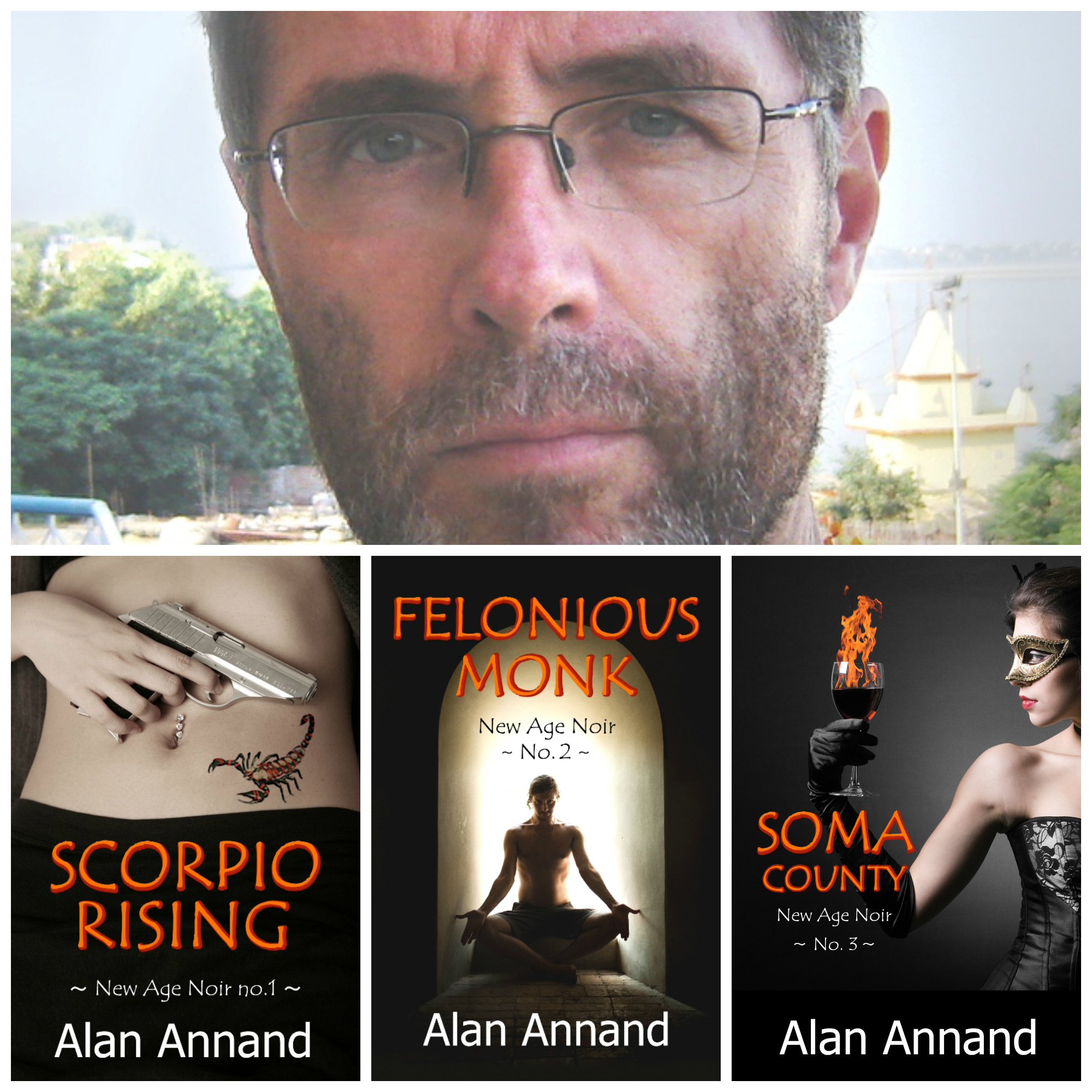
SOMA COUNTY: New Age Noir no.3

8 Oct

NewAgeNoir3A

It’s coming. The third installment in Alan Annand’s NEW AGE NOIR series, featuring astrologer extraordinaire Axel Crowe, will be released Fall 2015.

With rave reviews from The Mountain Astrologer, Stephen Forrest, Dell Horoscope, Michael Lutin and Horoscope Guide, this series delivers literary and esoteric crime fiction unlike anything else you’ve ever read.

The 5-star reviews: https://www.pinterest.com/alanannand/scorpio-rising/

“Annand portrays an investigator using an esoteric toolkit – astrology, palmistry, numerology – in a serious and effective way that shines new light on the so-called occult arts. Sherlock Holmes with a horoscope. ” ~ an Amazon reviewer


Michael Korda (b. October 8): “Finish your first draft and then we’ll talk.”

8 Oct
Korda

pinterest.com/pin/39406565464932078/

Michael Korda, born 8 October 1933, is an English-born writer and novelist who was editor-in-chief of Simon & Schuster in New York City.

Quotes about writing:

  1. Finish your first draft and then we’ll talk.
  2. Ask a book publisher how many copies a book has sold, and he or she, presuming you’re not the author, will probably try to remember the size of the first printing, then double it. If you’re the author, the publisher will try to remember the number of copies that were shipped and cut that in half in order to avoid encouraging you to expect a big royalty check.
  3. Escapism sold books, to be sure, but not nearly as many as were sold by exposing America’s flaws and making the average American reader (and book club member) look closely at his or her most cherished social assumptions. Americans might not be eager to accept integration, feminism, homosexuality, juvenile delinquency, and the drug culture – or to shoulder the blame for the existence of these problems – but they were certainly willing to read about them.

William Zinsser (b. October 7): “Writing is a craft not an art” & other quotes on writing

7 Oct
Zinsser1_CROP

pinterest.com/pin/39406565464926822/

William Zinsser, born 7 October 1922, is an American writer, editor, literary critic, and teacher. He is best known for the book, On Writing Well.

10 quotes on writing:

  1. Writing is a craft not an art.
  2. You learn to write by writing.
  3. Clear thinking becomes clear writing; one can’t exist without the other.
  4. Rewriting is the essence of writing well: it’s where the game is won or lost.
  5. Writers must constantly ask: what am I trying to say? Surprisingly often, they don’t know.
  6. Examine every word you put on paper. You’ll find a surprising number that don’t serve any purpose.
  7. Nothing has replaced the writer. He or she is still stuck with the same old job of saying something that other people will want to read.
  8. The reader will notice if you are putting on airs. Readers want the person who is talking to them to sound genuine. Therefore a fundamental rule is: be yourself.
  9. Clutter is the disease of American writing. We are a society strangling in unnecessary words, circular constructions, pompous frills and meaningless jargon.
  10. Many people assume that professional writers don’t need to rewrite; the words just fall in place. On the contrary, careful writers can’t stop fiddling.

Thus Spoke Kamasutra: “By getting a hand under her, you will get a leg over her.”

6 Oct

nietzsche

“By getting a hand under her, you will get a leg over her.”

~ THUS SPOKE KAMASUTRA, Friedrich Nietzsche

http://pinterest.com/pin/39406565461961087/


Clive Barker (b. October 5th): “Horror is the wild-dog genre” & other quotes on writing

5 Oct

barker

Clive Barker (born 5 October 1952) is an English author, film director, video game designer and visual artist known for his work in both fantasy and horror fiction. He is best-known for his short stories which were adapted for film as the Hellraiser and Candyman series. He has also written 18 novels.

Eight quotes about writing:

  1. I firmly believe that a story is only as good as the villain.
  2. Books should make somebody look at how they feel, be honest with themselves.
  3. Nothing ever begins. There is no first moment; no single word or place from which this or any other story springs.
  4. Gather experience… Look at what you should not look at. A feeling of anxiety is the sure and certain evidence that you should do this.
  5. Horror fiction shows us that the control we believe we have is purely illusory, and that every moment we teeter on chaos and oblivion.
  6. By and large, horror fiction is the most difficult to domesticate because part of the point is that it’s one step ahead – or behind – everybody else’s taste. And I’m not really convinced I’d like it to change. There’s something very healthy about horror fiction being always a little bit on the outside. It’s the wild-dog genre.
  7.  One of the things I’m trying to do over and over again in my books is create new mythologies, create new ways to understand the complexity of the world. I think what mythology does is impress upon chaotic experience the patterns, hierarchies and shapes which allow us to interpret the chaos and make fresh sense of it.
  8. Movies are much more fascist than books. They tell you what to feel, when to feel it. Popular movies manipulate you. Music tells you when it’s a sad part and when it’s a happy part. You’re obliged to watch them at the speed the filmmaker has created for you. That, I think, is one of the reasons why they’re so popular – because you don’t have to think very hard. The filmmaker has done all the thinking for you.