Archive | Science RSS feed for this section

Back-to-School Immune-Boosting Supplements

16 Nov

Kids are messy. I worked at a daycare for a period of time and I can testify that kids will use anything to wipe their nose: a desk, a coloring book, a shirt, someone else’s shirt. Part of my job was to be a human tissue, and there was nothing I could do about it. During my first six months working there, I got sick constantly, and saw many of the children I cared for come down with cycles of colds and flus.

Back-to-school time might as well be called back-to-rubbing-your-germs-all-over-your-friends time

Starting from the end of September with the weather change and continuing until about March or April is the infamous “flu season”. Many parents find themselves missing work to care for sniffly children, while struggling to keep themselves well. Reducing the amount of time a child gets sick and moderating the severity of their symptoms can go a long way to maintaining parental sanity. Isn’t the epidemic of head lice enough??

In contracting infections, there are two main routes of entry: The mouth and the nose. Train your children to wash their hands frequently and not to eat or put their fingers in their mouth or nose before washing their hands. Failing this practice, there is one super hero protecting us: The Immune System.

So, what can you do to build up your child’s immune system this fall?

1. Reduce sugar as much as possible

Oh, this is a tough one, but it is so very important. It doesn’t mean being “mean mommy” all year long and always denying your children birthday cake or the occasional cookie, but it does mean being conscious of hidden sources of sugar in your child’s diet and truly making treats a treat, rather than an everyday expectation.

Many conventional cereals, jams, flavoured yogurts, granola bars, fruit drinks, and even certain condiments pack more sugar than you would imagine. Sugar directly inhibits the immune system and also competes for absorption with vitamin C. Because the cell usually prefers glucose, less vitamin C is absorbed, and vitamin C is an essential immune nutrient! Slowly wean children off sugar and teach them to prefer fruit over candy. Be patient; it’s possible!

2. As time indoors increases, so should vitamin D supplementation

Is it a coincidence that the flu season coincides with the months where we are less likely to spend outside in the sun? Maybe, but we definitely get less sun exposure in the fall and winter and therefore less vitamin D. Lots of studies have shown that individuals with lower levels of vitamin D are more susceptible to illness, so make sure you are keeping those D levels up! 400 to 1,000 IU per day is an appropriate dose for most children, depending on age.

3. Befriend bacteria (the good kind)

Most people think of digestive health when probiotics are mentioned, but did you know that 70% of your immune tissue lives in your gut? Probiotics help defend our bodies and fight off foreign invaders like pathogenic bacteria and viruses. Kids, especially the younger ones, seem to assess the world though the mouth. Two year old Henry might think, “Not sure about this colourful elastic band I just found under the couch…I better stick it in my mouth to get a better reading”. You can bet a child’s digestive tract comes into contact with some interesting things, so keeping their tummies full of “good guys” is a good call. Look for powders or great tasting chewable probiotics.

4. Stock your herbal dispensary

Herbs aren’t just for old hippies! There are lots of botanicals that are safe for young children. Astragalus, echinacea, black currant, camu camu berry, and elderberry are all safe to use with kids for both preventative and treatment purposes. Look for a camu camu berry powder that can be slipped into a smoothie at 250mg of vitamin C per ½ teaspoon! Professional staff in a good health food store can help you find the right product and the right brand.

These tips are a great starting off point but if you’d like more personalized advice for your child, book an appointment with a qualified holistic practitioner. Sometimes deeper issues are inhibiting your child’s ability to fight off illness, and a holistic practitioner can help uncover those causes.

And for the record, all of these tips are relevant for adults too, so the next time your little guy sneezes directly into your mouth, you’ll be prepared.


Alex-round_EDITAlex Picot-Annand, BA (Psych), is a Registered Holistic Nutritionist & Certified Life Coach in Toronto, Canada. She provides consultations, face-to-face for local clients, or by phone for those at a distance. Follow her on Twitter at @alexpicotannand.

Arthur C. Clarke: Prophet of the Digital Age

11 Oct
Clarke_CROP

pinterest.com/pin/39406565464944465/

Guest post by Brandon Engel:

Touted as one of science fiction’s “Big Three” alongside Robert A. Heinlein and Isaac Asimov, writer Arthur C. Clarke is warmly remembered, not merely for his prose, but his many contributions to universal knowledge across several different disciplines.

Geosynchronous Satellite Networks

In 1945, Clarke published an essay entitled Extra-Terrestrial Relays: Can Rocket Stations Give World-Wide Radio Coverage? which proposed a geosynchronous satellite communication network. Clarke’s time as a radar technician with the Royal Air Force likely contributed to this. The article also anticipated the creation of the International Space Station (ISS), with Clarke writing: “Using material ferried up by rockets, it would be possible to construct a ‘space-station’ in such an orbit. The station could be provided with living quarters, laboratories and everything needed for the comfort of its crew, who would be relieved and provisioned by a regular rocket service. This project might be undertaken for purely scientific reasons as it would contribute enormously to our knowledge of astronomy, physics and meteorology.” It’s all the more astounding because this article was written 12 years before the launch of Sputnik.

The Internet and Personal Computers

In 1974, Clarke gave a memorable interview with the Australian Broadcasting Company. The interview was conducted in a room with a gigantic, primitive computer.  The interviewer asked Clarke what the world would be like for adults living in the year 2001. Without skipping a beat, Clarke then detailed his vision of both the web and personal computers. Clarke predicted that by 2001, people would have “not a computer as big as this” (in reference to the gargantuan apparatus filling the space around him) “but at least a console through which he can talk to his friendly local computer, and get all of the information he needs for his everyday life.” Clarke then went on to list bank statements and theater reservations as two examples of the information we might retrieve electronically in the future.

Clarke was not the only one of his contemporaries to predict the internet. Asimov, for example, had also made predictions about the internet as early as 1964. What distinguishes Clarke the most in this arena was his contribution to the conceptual development of wireless communications, which ultimately yielded everything from  transcontinental television broadcasts to high speed internet.

2001Skype and iPad

As a science fiction writer, Clarke will probably be best remembered by the general public for the script he penned for Stanley Kubrick’s 2001: A Space Odyssey (and the novelization of the screenplay that was written concurrent to the movie). It’s one of the greatest films of all time, and it really set the benchmark for every science fiction epic that followed it. Something that makes the film particularly novel for contemporary audiences are the video conferencing consoles used. While the technology looks laughably dated today, what Clarke envisioned was, essentially, Skype. Also notable are the use of what are ostensibly iPads.

What’s the lesson that modern consumers should take from all of this? To figure out what Apple is going to release in the next five years, read something that Clarke wrote 50 years ago.

~~~~~~~~~

Brandon Engel is a multimedia artist/blogger/cinephile/oddity collector based in Chicago, whose principal interests include vintage horror films, dated video games, and speculative fiction. Follow him on Twitter: @BrandonEngel2.

Book review: The Experiencers by Val Tobin

14 Jun

the experiencersFor anyone who’s ever lent credence to the notion that aliens visit Earth, The Experiencers by Val Tobin is frighteningly real. Michael Valiant is a black ops assassin for a government agency that shields alien presence from public knowledge by silencing UFO researchers who know they are here among us. Carolyn Fairchild is a psychic medium who functions as a sort of spotter for her local research group, and when they see something they shouldn’t, Valiant and his partner are dispatched to shut them up before they blog about it.

Just when Carolyn’s group starts having fatal accidents at the agency’s hands, Valiant has a crisis of faith. He’s discovered our government is in league with the alien “establishment”, with the joint goal of global subjugation. But Valiant learns there’s a rebel alien base in a wilderness park, whose mission is to work with the people, not against them. So instead of killing Carolyn, Valiant enlists her help to find the base. Now the agency wants them both dead before they reach the rebels.

The Experiencers is written with a deft hand, and well-paced between thoughtful character development and straight-on action scenes. Lurking in the background is some entirely plausible bleeding edge technology. The few psychic episodes are both real and out there. And for the tender-hearted, there are a couple of poignantly human sex scenes between two people thrown together by fate and accepting it. Meanwhile, pursued by government men with stones where their hearts should be…

Amazon, Apple, Barnes&NobleSmashwords

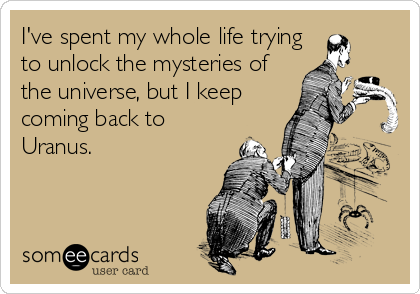
What’s so funny about Uranus?

18 May

I don’t know why so many people like to make jokes about Uranus. We know it’s there but none of us have actually seen it. But if you want to have a laugh, here are a few reasons:

Uranus_specs

Uranus_model

Uranuscope

Uranus_talk

Uranus_explorerUranus_unlock

Charles Darwin (b. Feb 12): “A man who wastes time has not discovered the value of life.”

12 Feb

darwin_crop

“A man who dares to waste one hour of time has not discovered the value of life.”

~ Charles Darwin, b. 12 February 1809

http://www.pinterest.com/pin/39406565463646340/


Johannes Kepler (b. Dec 27): “I much prefer the sharpest criticism of a single intelligent man…”

27 Dec

Johannes Kepler Kopie eines verlorengegangenen Originals von 1610

“I much prefer the sharpest criticism of a single intelligent man to the thoughtless approval of the masses.”

~ Johannes Kepler, b. 27 December 1571

http://www.pinterest.com/pin/39406565463340867/