Archive | Literary marketplace RSS feed for this section

Evelyn Waugh (b. October 28): “An artist must be a reactionary” & other quotes on writing

28 Oct

waughEvelyn Waugh (born 28 October 1903, died 10 April 1966) was an English author, born into a family of publishers and writers. Waugh’s first book, A Life of Dante Gabriel Rossetti, was published in 1928. Soon afterwards his first novel, Decline and Fall, appeared and his career was sensationally launched. Evelyn Waugh wrote 15 novels and several acclaimed travel books, two additional biographies, and an autobiography, A Little Learning

Quotes on writing:

  1. I put words down and push them around a bit.
  2. There are no poetic ideas, only poetic utterances.
  3. Some people think in pictures, some in ideas. I think entirely in words. 
  4. One forgets words as one forgets names. One’s vocabulary needs constant fertilizing or it will die.
  5. An artist must be a reactionary. He has to stand out against the tenor of the age and not go flopping along.
  6. Only when one has lost all curiosity about the future has one reached the age to write an autobiography.
  7. Sometimes, I feel the past and the future pressing so hard on either side that there’s no room for the present at all.
  8. I should like to bury something precious in every place where I’ve been happy and then, when I’m old and ugly and miserable, I could come back and dig it up and remember.
  9. I used to have a rule when I reviewed books as a young man: never to give an unfavorable notice to a book I hadn’t read. I find even this simple rule is flagrantly broken now. 
  10. Don’t analyse yourself. Give the relevant facts and let your readers make their own judgments. Stick to your story. It is not the most important subject in history but it is one about which you are uniquely qualified to speak.

Jonathan Stroud (b. October 27): “Try different kinds of writing” & other quotes

27 Oct

Jonathan Stroud, born 27 October 1970, is an author of fantasy books, mainly for children and young adults. He is best known for the Bartimaeus Trilogy.

Quotes on writing:

  1. Practise: Write as much and as often as possible.
  2. Read: As above, as much and as widely as you can.
  3. Experiment: Try as many different kinds of writing as you can.
  4. When I write something that would have made me laugh as a 10-year-old, or would have scared me or would have excited me, I know I’m onto something.
  5. When I was young, I kept a diary for about 10 years and I had to write in it every day. Even on days when nothing seemed to happen, I made myself think of something to put in it.
  6. The important thing about any book is that you have to have a good story and that it has to be exciting. Then it’s nice to add other levels underneath that people can pick up on.
  7. As an author, you need to keep talking to your audience to remind yourself what they like and what they don’t like. You spend most of your life locked in a room, and you need to be social occasionally.

How to post a book review on Amazon

24 Oct

dirty-dozen

How to post a book review on Amazon

If you’ve never posted a book review on Amazon before, here are the simple steps to follow (and make an indie writer’s day):

First, go to Amazon.com, because that’s where all of the readers are.

See the search field at the top of the Amazon page and use the pull-down menu on the left to select “Books.” Type in the author’s name, <enter> and this will take you to the author’s books.

Click on the book you want to review. This takes you to another page, with a description of the book and some information about the author. Scroll down to the review section, where you’ll see a graph showing reviews with 1-5 star ratings. Click on the “Write a customer review” button to the right.

That takes you to the book’s review page. If it’s a novel, you’ll see questions. (If the book is non-fiction, these questions won’t appear):

  • How would you describe the plot?
  • Which of these words best describe the mood?
  • How would you describe the pace?
  • How would you describe the characters?

Several boxes are provided under each question to cover your probable responses. Click one under each question and move on.

You’ll next be offered to submit a 1-5 star rating. As soon as (but not before) you click a number of stars, a comment field will appear just below that, where you can write anything from a sentence to a few paragraphs of review.

As soon as you start writing comments, another field will appear below that, with space to write a headline for your review. Write something brief and/or catchy, so that all three items (headline, body, rating) will appear together once posted.

Once you’ve entered all the requisite fields, click the yellow “Submit” button in the lower right, and that’s it.

Thank you for your support!


Marina Lewycka (b. October 12): “Comedy can expose the soul” & other quotes on writing

12 Oct

Marina Lewycka, born 12 October 1946, is a British novelist of Ukrainian origin. Her debut novel A Short History of Tractors in Ukrainian was long-listed for the 2005 Man Booker Prize and short-listed for the 2005 Orange Prize for Fiction.

Six quotes on writing:

  1. One of the nice things about being a writer is that no one recognizes you. 
  2. I’m a huge fan of Chaucer, he has the most wonderful characters, and I drew on him a lot for Two Caravans.
  3. My preferred place to write is in bed propped up with lots of cushions, and a nice pot of tea on a tray – but it can be hard on the back.
  4. I like to learn something as I write. I often start out with a subject I don’t know very much about and finding out more makes the process more interesting. 
  5. You think comedy isn’t serious, but with comedy you can say such a lot that serious can’t. Comedy can expose the depths of the soul; funny is what we are when we least intend to be.
  6. You must have a good story and find the right voice to tell it. Another useful tip is show, don’t tell. In other words, don’t write that a character behaved badly, show us their bad behavior instead.

Harold Pinter (b. October 10): “Language is a trampoline” & other quotes on writing

10 Oct

Harold Pinter (10 October 1930 – 24 December 2008) was a Nobel Prize-winning English playwright, screenwriter, director and actor. His best-known plays include The Birthday PartyThe Homecoming, and Betrayal, each of which he adapted for the screen. His screenplay adaptations of others’ works include The French Lieutenant’s Woman and The Trial

Six quotes on writing:

  1. Good writing excites me, and makes life worth living.
  2. One way of looking at speech is to say that it is a constant stratagem to cover nakedness.
  3. I don’t give a damn what other people think. It’s entirely their own business. I’m not writing for other people.
  4. Language in art remains a highly ambiguous transaction, a quicksand, a trampoline, a frozen pool which might give way under you … at any time.
  5. I’m not committed as a writer, in the usual sense of the term, either religiously or politically. And I’m not conscious of any particular social function. I write because I want to write. I don’t see any placards on myself, and I don’t carry any banners.
  6. I think we communicate only too well, in our silence, in what is unsaid, and that what takes place is a continual evasion, desperate rearguard attempts to keep ourselves to ourselves. Communication is too alarming. To enter into someone else’s life is too frightening. To disclose to others the poverty within us is too fearsome a possibility.

D.H. Lawrence (b. September 11): “Tragedy is like strong acid…”

11 Sep

lawrence

“Tragedy is like strong acid – it dissolves away all but the very gold of truth.”

~ D.H. Lawrence. b. 11 September 1885

pinterest.com/pin/39406565462792624/


Not waiting for Godot any longer…

30 Aug

beckett5

Samuel Beckett, author of Waiting for Godot, is now tired of waiting, and is coming to get Godot, and boy, is he going to get it!

SOMA COUNTY: book review by ISAR’s “International Astrologer” Journal

28 Aug

Pageflex Persona [document: PRS0000031_00006]If the title looks like it belongs on a novel, well, that’s because Soma County is a novel. Specifically, it’s a crime novel. If you’re now wondering why a crime novel is being reviewed here [ISAR Journal], well, possibly you’ve never encountered Alan Annand before. Annand is an accomplished writer of suspense novels; he is also an accomplished Vedic astrologer with a solid grasp of Eastern and Western astrology, palmistry, and more.

He has imbued his protagonist, Axel Crowe, with this knowledge and set him loose in what he calls his New Age Noir series. This is the third book in that series, but you don’t need to have read the other two to understand Crowe (though, as with an old friend, his character has deepened and become more clear with each novel). And Crowe for the most part is a likeable guy – as is his former guru who is an invisible but very definite presence in this book.

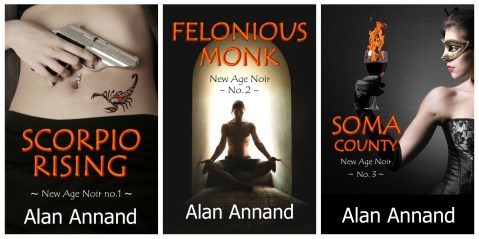
newagenoir 3The plot? A beautiful woman dies at a wine tasting at a California vineyard owned by the woman’s close friend and the friend’s husband. The police assume it was a tainted batch of wine. When Crowe is called in by the friend, he suspects otherwise. Who would want to put the vineyard in jeopardy? Hmm… There are several possibilities – a developer, assorted workers (one of whom turns up missing), and perhaps other vintners hoping to capitalize on this vineyard’s ruined reputation.

But this is no simple whodunit. The action takes you from the Napa Valley to India and back again. And along the way, a black market in body parts adds to the intrigue. Am I going to tell you more? Only that the characters are well developed, the plot is rich and fast-paced, and Crowe is very generous in relaying snippets of astrology, numerology, and Vedic lore. Consider this a painless introduction to some very basic astrological principles as well as a thriller you won’t want to put down.

NewAgeNoir3aaNon-astrological readers tend to appreciate Annand’s books every bit as much as we [astrologers] do, so if you want to sneakily pique somebody’s interest in astrology, do leave this book lying about. And if you haven’t read the first two in the series, consider getting them as well if you like this one. Scorpio Rising and Felonious Monk are equally good.

– Reviewed by Donna Van Toen, August 2016 issue of ISAR’s International Astrologer Journal. (International Society for Astrological Research)

~~~

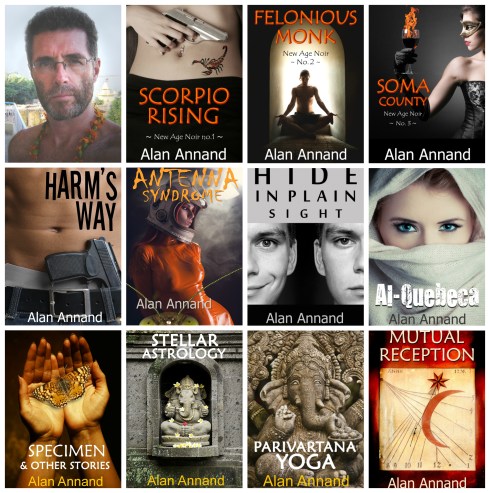
Alan Annand is an astrologer and writer. You can find his books on Amazon, Apple, Barnes&Noble, Kobo and Smashwords.

Jeannette Winterson (b. August 27): 10 Rules for Writing

27 Aug

winterson

Jeannette Winterson (b. 27 August 1959

pinterest.com/pin/39406565464702537/

10 Rules for Writing

  1. Turn up for work. Discipline allows creative freedom. No discipline equals no freedom.
  2. Never stop when you are stuck. You may not be able to solve the problem, but turn aside and write something else. Do not stop altogether.
  3. Love what you do.
  4. Be honest with yourself. If you are no good, accept it. If the work you are ­doing is no good, accept it.
  5. Don’t hold onto poor work. If it was bad when it went in the drawer it will be just as bad when it comes out.
  6. Take no notice of anyone you don’t respect.
  7. Take no notice of anyone with a ­gender agenda. A lot of men still think that women lack imagination of the fiery kind.
  8. Be ambitious for the work and not for the reward.
  9. Trust your creativity.
  10. Enjoy this work!

Ernest Hemingway (b. July 21): “We are all apprentices…”

21 Jul

hemingway

“We are all apprentices in a craft where no one ever becomes a master.”

~ Ernest Hemingway, b. 21 July 1899

pinterest.com/pin/39406565462500481/