My novel “Al-Quebeca” ripped from tomorrow’s headlines

10 Oct

Ebook Al Quebeca v4darker charcoal thumbFor years nothing happens. Then everything happens at once. This applies both to writing novels and launching terror strikes.

For the record, I’m a writer, not a terrorist, although I admit to a fascination with the latter. As a Canadian, I’ve watched terror events unfold across the world with frightening speed and consequences. These events usually occur at a distance, allowing Canadians to be mere spectators rather than forced participants. But sometimes, things happen right in our backyard.

In 1999 the LAX bomber, Ahmed Ressam, was intercepted in Port Angeles, WA, with a carload of explosives destined for the LA airport. He’d entered Canada in 1994 with a forged French passport and lived in Montreal for almost five years, surviving by stealing airport luggage. After a trip to Afghanistan where he learned how to build bombs, the RCMP began following him, and alerted US authorities when he crossed the border from Vancouver en route to Los Angeles.

In 2006, the Canadian Security Intelligence Service (CSIS) arrested a group of jihadists, the Toronto 18, as they took delivery of three tonnes of ammonium nitrate with which they’d planned to build massive bombs in U-Haul trailers. Their targets: the Toronto Stock Exchange, the CSIS offices in downtown Toronto, and a military base. After the bombs, they would storm Parliament, seize the Cabinet and behead the Prime Minister, all in time for the evening news and instant fame via al-Jazeera. But the Toronto 18 had been infiltrated and monitored for over a year by 700 security officers gathering evidence via 80,000 electronic intercepts.

skull-bomb@50%In April 2013, following hard on the heels of the Boston Marathon bombings, two men with alleged al-Qaeda connections were arrested in Canada for plotting to derail a Canadian train travelling from Toronto to New York. Turns out there may have been an Iranian connection, wherein financial or technical aid was provided on behalf of al-Qaeda.

Apparently, news of that domestic terrorist plot raised only tepid interest from the US media, while the Twitter-verse responded with several jokes on the subject. Understandably, a neutralized threat in Canada pales in comparison to exploding bombs in Boston, but seriously, folks… Just because Canadians are liberal and polite doesn’t mean our society is any less liable than America’s in unwittingly harboring terrorists in our midst. Quite the contrary.

I wrote the first draft of my novel Al-Quebeca in 2009 and revised it several times over subsequent years. Each time it all seems even more inevitable. The plot involves an al-Qaeda sleeper cell in Montreal summoned to life by order of a Paris-based mullah. Although Osama bin Laden is dead and gone, he’d issued a fatwa several years ago, vowing revenge against any country, Canada included, that had sided with America in the Iraq and Afghanistan wars.

In Al-Quebeca, the Montreal terrorist plot involves a simultaneous three-pronged strike: to sabotage the Hydro-Quebec electrical grid that supplies power to Boston and New York, behead the visiting Governor of New York and, for body-count bonus points, kill thousands of hockey fans with nerve gas.

Preposterous? Not really. For years the CIA has warned CSIS that Montreal, where almost one in four residents is Muslim or has ties to Arabic-speaking homelands, is a hot-bed of al-Qaeda sleeper cells awaiting the call to jihad. We all think it could never happen here. Until it does.

guns_in_the_sky(Currently, in a case of life mirroring art, the radical jihadist group ISIS is encouraging independent acts of terrorism in every western country that participates in the US-led coalition against their brutal insurrection in Iraq and Syria.)

In Al-Quebeca, the heroine Sophie Gillette is a Montreal homicide detective dispatched in the middle of a snowstorm to investigate the suspicious hit-and-run death of an Iranian engineer who worked for Hydro-Quebec. Defying easy resolution, the case launches her on a collision course with biker wars, arms smuggling and, unexpectedly, a terrorist plot.

In the course of her investigation, Gillette uncovers militant students at Concordia University, drug financiers and a rogue professor with a PhD in chemical toxicology. All are linked to a shadowy figure called al-Quebeca whom Gillette must track to a brutal confrontation.

I just hate to be prescient, but as Aldous Huxley once said, The trouble with fiction is that it makes too much sense.

But don’t take my word for it. Read Al-Quebeca and judge for yourself.

You can purchase it at Amazon, Apple, Barnes&Noble, Kobo or Smashwords.


The early Beatles: John, Paul, George & Bingo

9 Oct

early_beatles

This rare archival photo, from the Library of Liverpool, shows the earliest-known photo of the Beatles. Shown here are John Lennon, Paul McCartney, George Harrison and William “Bingo” Murphy. Murphy, who fancied himself a vocalist in the style of Frank Sinatra, played no instrument and wasn’t interested in learning. The other band members, already observing the early trend in skiffle and rockabilly, knew they needed a drummer.
Within a year, Bingo was replaced by Richard “Ringo” Starkey. Murphy was furious and tried to get his father, a barrister, to launch a breach-of-promise suit against the group, then known as The Swinging Stevedores, in order to be reinstated. But when John Lennon came up with a new name for the group, Murphy, who was absolutely terrified of bugs, knew he could never be part of The Beatles.

http://pinterest.com/pin/39406565462553171/

PS… Happy Birthday, John Lennon, born 9 October 1940!

~~~

 This was a faux news item from Alan Annand, writer and astrologer.

(c) SEXTILE: It might not be true, but you heard it here first!

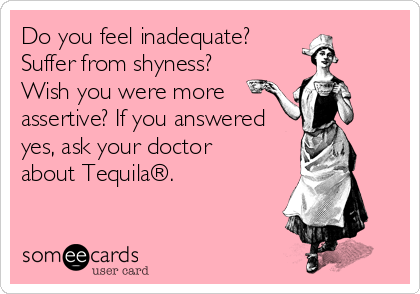
Benefits of Tequila® start immediately.

9 Oct

tequila_3

 eCard by Alan Annand, writer and astrologer


Belva Plain (b. October 9): “Read the best there is and thereby learn.”

9 Oct
plain1

pinterest.com/pin/39406565464936917/

Belva Plain (9 October 1915 – 12 October 2010) was an American author. Over 30 million copies of her novels were printed in 22 languages. 21 of her novels appeared on the New York Times best-seller list.

Six quotes about writing:

  1. I’m an early riser, and morning is my work time. I have a special workroom where no one interrupts me except my dog.
  2. I write in longhand on a yellow pad. I don’t use a computer because I like to take time to think about what I’m saying. 
  3. I think it’s as difficult for me to describe the process of inspiration as it would be for a composer to tell how a melody took shape in his/her head. 
  4. My advice to would-be writers? READ. Read the best there is and thereby learn. And keep trying. Writing isn’t easy. It’s very hard work, requiring a lot of blood, sweat, and tears.
  5. I wrote Evergreen because I had to. I had no real idea that it might be published. I know how competitive the world is and I didn’t want to become the sad victim of false hopes.
  6. I thought it was time to write about the kind of people I know. I got sick of reading the same old story, told by Jewish writers, of the same old stereotypes – the possessive mothers, the worn-out fathers, all the rest of the neurotic rebellious unhappy self-hating tribe. I wanted to write a different novel about Jews – and a truer one.

John Lennon (b. October 9): “Possession isn’t nine-tenths of the law…”

9 Oct

Lennon

“Possession isn’t nine-tenths of the law. It’s nine-tenths of the problem.”

~ John Lennon, b. 9 October 1940

http://www.pinterest.com/pin/39406565460811271/


Stop hiding, start living with Tequila®.

8 Oct

tequila_2

 eCard by Alan Annand, writer and astrologer


Michael Korda (b. October 8): “Finish your first draft and then we’ll talk.”

8 Oct
Korda

pinterest.com/pin/39406565464932078/

Michael Korda, born 8 October 1933, is an English-born writer and novelist who was editor-in-chief of Simon & Schuster in New York City.

Quotes about writing:

  1. Finish your first draft and then we’ll talk.
  2. Ask a book publisher how many copies a book has sold, and he or she, presuming you’re not the author, will probably try to remember the size of the first printing, then double it. If you’re the author, the publisher will try to remember the number of copies that were shipped and cut that in half in order to avoid encouraging you to expect a big royalty check.
  3. Escapism sold books, to be sure, but not nearly as many as were sold by exposing America’s flaws and making the average American reader (and book club member) look closely at his or her most cherished social assumptions. Americans might not be eager to accept integration, feminism, homosexuality, juvenile delinquency, and the drug culture – or to shoulder the blame for the existence of these problems – but they were certainly willing to read about them.

Feel inadequate? Try Tequila®.

7 Oct

tequila_1

 eCard by Alan Annand, writer and astrologer

William Zinsser (b. October 7): “Writing is a craft not an art” & other quotes on writing

7 Oct
Zinsser1_CROP

pinterest.com/pin/39406565464926822/

William Zinsser, born 7 October 1922, is an American writer, editor, literary critic, and teacher. He is best known for the book, On Writing Well.

10 quotes on writing:

  1. Writing is a craft not an art.
  2. You learn to write by writing.
  3. Clear thinking becomes clear writing; one can’t exist without the other.
  4. Rewriting is the essence of writing well: it’s where the game is won or lost.
  5. Writers must constantly ask: what am I trying to say? Surprisingly often, they don’t know.
  6. Examine every word you put on paper. You’ll find a surprising number that don’t serve any purpose.
  7. Nothing has replaced the writer. He or she is still stuck with the same old job of saying something that other people will want to read.
  8. The reader will notice if you are putting on airs. Readers want the person who is talking to them to sound genuine. Therefore a fundamental rule is: be yourself.
  9. Clutter is the disease of American writing. We are a society strangling in unnecessary words, circular constructions, pompous frills and meaningless jargon.
  10. Many people assume that professional writers don’t need to rewrite; the words just fall in place. On the contrary, careful writers can’t stop fiddling.

Simon Cowell (b. October 7): “Ending the animal trade would leave more time to trap popstar wannabes.”

7 Oct

simon_cowell_american_idol_3233

“The end of the animal trade would leave more time to trap or beat to death pop star wannabes.”

~ Simon Cowell, b. 7 October 1959

http://www.pinterest.com/pin/39406565462933738/