Archive | Literary marketplace RSS feed for this section

Yann Martel (b. June 25): “Art is a gift: you create and then you give away.”

25 Jun

martel

“Art is a gift: you create and then you give away. How readers receive that gift is their business. If they hate it, that’s their response to it. Others respond by liking it. Either way, that is their interaction with the book, which is no longer mine.”

~ Yann Martel, b. 25 June 1963

pinterest.com/pin/39406565464372842/

Anita Loos (b. April 26): “I love high style in low company.”

26 Apr

loosAnita Loos (born 26 April 1889, died 18 August 1981) was an American screenwriter, playwright and author, best known for her blockbuster comic novel, Gentlemen Prefer Blondes.

Nine Quotes:

  1. Fate keeps on happening.
  2. Memory is more indelible than ink.
  3. I’ve always loved high style in low company.
  4. It isn’t that gentlemen really prefer blondes, it’s just that we look dumber.
  5. A kiss on the hand may feel very, very good, but a diamond and sapphire bracelet lasts forever.
  6. On a plane you can pick up more and better people than on any other public conveyance since the stagecoach.
  7. The rarest of all things in American life is charm. We spend billions every year manufacturing fake charm that goes under the heading of public relations. Without it, America would be grim indeed.
  8. There is a serious defect in the thinking of someone who wants – more than anything else – to become rich. As long as they don’t have the money, it’ll seem like a worthwhile goal. Once they do, they’ll understand how important other things are – and have always been.
  9. I can never take for granted the euphoria produced by a cup of coffee. I’m grateful every day that it isn’t banned as a drug, that I don’t have to buy it from a pusher, that its cost is minimal and there’s no need to increase the intake. I can count on its stimulation 365 mornings every year. And thanks to the magic in a cup of coffee, I’m able to plunge into a whole day’s cheerful thinking.

James Franco (b. April 19): “You want to be interesting? Be interested.”

19 Apr

francoJames Franco (born 19 April 1978) is an American actor, director, screenwriter, producer, teacher, author and poet. His books include Palo Alto, Actors Anonymous: A Novel, and A California Childhood. Franco has also written, directed and starred in several short plays, two of which — Fool’s Gold and The Ape — he adapted into feature-length films. He wrote and directed the film Good Time Max.

Quotes:

  1. You want to be interesting? Be interested.
  2. They say living well is the best revenge but sometimes writing well is even better.
  3. Sometimes it’s painful to be oneself; at other times it seems impossible to escape oneself.
  4. Always have one artistic thing that is pure, at least one thing, where you don’t compromise. You can do other things to make money, but have one pure area.
  5. Make your characters interested in something. Striving for something. In need of something. Good at something. This will make them likeable and interesting.
  6. You also need love. Your characters need to love something, otherwise they will be unlovable.
  7. I’m a huge Cormac McCarthy fan and have read every book of his.

Kingsley Amis (b. April 16): “If you can’t annoy somebody, there’s little point in writing.”

17 Apr

(c) Gordon Stuart; Supplied by The Public Catalogue Foundation

Kingsley Amis (born 16 April 1922, died 22 October 1995) was an English novelist, poet, critic, and teacher. He wrote more than 20 novels, six volumes of poetry, a memoir, various short stories, radio and television scripts, and social and literary criticism. He was the father of English novelist Martin Amis.

Quotes:

  1. If you can’t annoy somebody, there’s little point in writing.
  2. No wonder people are so horrible when they start life as children.
  3. The novelist always has favorites, and often he’s a minor character.
  4. Laziness has become the chief characteristic of journalism, displacing incompetence.
  5. It is natural and harmless in English to use a preposition to end a sentence with.
  6. Writing for me is to a large extent self-entertainment, and an only child is driven to do that.
  7. No writer, especially a young and unknown writer, resents publicity of any kind – whatever he may say.
  8. You can’t imagine how much I miss the intellectual stimulus of teaching English literature to young people. More than I ever realized – I do miss it.
  9. I don’t get up very early. I linger over breakfast reading the papers, telling myself hypocritically that I’ve got to keep up with what’s going on, but really staving off the dreadful time when I have to go to the typewriter. Then I go on until about eight-thirty PM and I always hate stopping.
  10. I’ve been trying to write for as long as I can remember. But those first 15 years didn’t produce much of great interest. I mean, it embarrasses me very much to look back on my early poems – very few lines of any merit at all and lots of affectation. But there were quite a lot of them. That’s a point in one’s favor.

Felonious Monk: Axel Crowe is an astrologer action hero

14 Apr

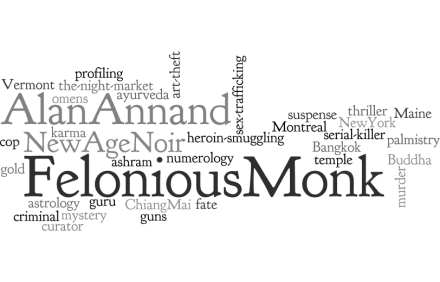
AA_FM_1“Axel Crowe, hero of Alan Annand’s New Age Noir mystery series, is the perfect blend of detective, astrologer, mystic and martial artist. Felonious Monk, the second of the series, engages and entertains in just the right proportions. The intricate plot involves a dead guest at a Vermont ashram, a serial killer of Asian women in New York, and a golden Buddha stolen from a Bangkok temple.

Annand weaves his story with irony, wit, information and insight, not to mention some high action scenes. Crowe is a steady, humble, highly brilliant and somewhat fearless hero. But despite his attractions, he feels no need to prove himself a James Bond, rather, he’s sexually circumspect. (Think hot, but restrained.) It’s hard not to respect the way he lives, with a spiritual practice as rigorous as his martial.”

~ Julie Simmons, Astrology Toronto
Felonious 4http://www.amazon.com/Alan-Annand/e/B0052MM0POhttps://itunes.apple.com/us/artist/alan-annand/id442957999http://www.barnesandnoble.com/c/alan-annandhttp://store.kobobooks.com/en-CA/Search?Query=Alan+Annandhttps://www.smashwords.com/profile/view/AlanAnnand

Alice Hoffman (b. March 16): “Books may well be the only true magic.”

16 Mar
hoffman

pinterest.com/pin/39406565465842605/

Alice Hoffman, born 16 March 1952, is an American novelist best known for her novel Practical Magic, which was adapted for a film of the same name. Many of her works fall into the genre of magic realism.

Quotes on writing:

  1. Books may well be the only true magic.
  2. No one knows how to write a novel until it’s been written.
  3. You can’t dispute the ridiculous. You can’t argue reasonably with evil.
  4. I think love is a huge factor in fiction and in real life. Is there a risk? Always. In fiction and in life.
  5. That is the joy of reading fiction: when all is said and done, the novel belongs to the reader and his or her imagination.
  6. After a while, the characters I’m writing begin to feel real to me. That’s when I know I’m heading in the right direction.
  7. I’ve been a screenwriter for twenty-five years. Every one of my books have been optioned for movies and I have written a few of those screenplays.
  8. All the characters in my books are imagined, but all have a bit of who I am in them – much like the characters in your dreams are all formed by who you are.
  9. The original fairy tale was about the youngest sister going into a room in the castle and finding all the bodies of the wives that came before her – she is confronted with truth, thinking about how often we think we know people and we really don’t.
  10. My theory is that everyone, at one time or another, has been at the fringe of society in some way: an outcast in high school, a stranger in a foreign country, the best at something, the worst at something, the one who’s different. Being an outsider is the one thing we all have in common.


Khaled Hosseini (b. March 4th): “Literary fiction is kept alive by women…”

4 Mar

Los Angeles Premiere of "The Kite Runner"

“Literary fiction is kept alive by women. Women read more fiction, period.”  

~ Khaled Hosseini, b. 4 March 1965

pinterest.com/pin/39406565463767903/


Elizabeth George (b. February 26): “I have to know the killer…”

26 Feb
george

pinterest.com/pin/39406565465739058/

Elizabeth George, born 26 February 1949, is an American author of mystery novels set in Great Britain. 11 of her novels have been adapted for television by the BBC as The Inspector Lynley Mysteries.

Quotes on writing:

  1. It is the job of the novelist to touch the reader.
  2. I wish that I’d known back then that a mastery of process would lead to a product. Then I probably wouldn’t have found it so frightening to write.
  3. I find it both fascinating and disconcerting when I discover yet another person who believes that writing can’t be taught. Frankly, I don’t understand this point of view.
  4. I have to know the killer, the victim and the motive when I begin. Then I start to create the characters and see how the novel takes shape based on what these people are like.
  5. Essentially and most simply put, plot is what the characters do to deal with the situation they’re in. It’s a logical sequence of events that grow from an initial incident that alters the status quo of the characters.
  6. Plotting is difficult for me, and always has been. I do that before I actually start writing, but I always do characters, and the arc of the story, first… You can’t do anything without a story arc. Where is it going to begin, where will it end.
  7. Lots of people want to have written; they don’t want to write. In other words, they want to see their name on the front cover of a book and their grinning picture on the back. But this is what comes at the end of a job, not at the beginning.

Victor Hugo (b. February 26): “Sorrow is a fruit…”

26 Feb

Hugo

“Sorrow is a fruit. God does not make it grow on limbs too weak to bear it.”   

~ Victor Hugo, b. 26 February 1802

 pinterest.com/pin/39406565463732504/


Richard North Patterson (b. February 22): “There’s a wonderful freedom to being a novelist.”

22 Feb

patterson_RN-crop

Richard North Patterson, born 22 February 1947, is an American best-selling fiction writer of 22 novels. Before he wrote full time, he studied creative writing at the University of Alabama. He was also a lawyer. He served as Ohio’s Assistant Attorney General, a Watergate prosecutor, and as an attorney for the Securities and Exchange Commission. His first novel, The Lasko Tangent, won an Edgar Allen Poe Award in 1979.

10 quotes on writing:

  1. The business of writing is empathizing with situations that aren’t your own.
  2. Writing seems like the only job where what you think and feel really matters.
  3. I was 29 when I wrote my first novel. But I was 45 when I quit for good. I was a 16-year overnight success.
  4. There is a wonderful freedom to being a novelist – it’s self-assigned work. For someone who’s curious by nature, it’s a perfect job.
  5. The manuscript you submit [should not] contain any flaws that you can identify – it is up to the writer to do the work, rather than counting on some stranger in Manhattan to do it for him.
  6. Writing is re-writing. A writer must learn to deepen characters, trim writing, intensify scenes. To fall in love with the first draft where one cannot change it is to greatly enhance the prospect of never publishing.
  7. Trial lawyers have to be story tellers. They have to arrange complex facts in attractive narratives; grasp character; understand judges, juries, make clients appealing, understandable. They do have a lot of stories to tell – vivid and interesting things to talk about.
  8. Write what you care about and understand. Writers should never try to outguess the marketplace in search of a saleable idea; the simple truth is that all good books will eventually find a publisher if the writer tries hard enough, and a central secret to writing a good book is to write one that people like you will enjoy.
  9. Monday through Friday, I get up at five, read The New York Times and begin writing by seven. I work with an outline of the chapter or scenes from each day and typically finish with original writing by noon. Throughout the afternoon my assistant and I work the draft over until it’s as good as it can be. Typically we’re not happy until late afternoon.
  10. The writer must always leave room for the characters to grow and change. If you move your characters from plot point to plot point, like painting by the numbers, they often remain stick figures. They will never take on a life of their own. The most exciting thing is when you find a character doing something surprising or unplanned. Like a character saying to me: “Hey, Richard, you may think I work for you, but I don’t. I’m my own person.”