

“Life is always a tightrope or a feather bed. Give me the tightrope.”
~ Edith Wharton, b. 24 January 1862
“Life is always a tightrope or a feather bed. Give me the tightrope.”
~ Edith Wharton, b. 24 January 1862

“There aren’t many shy writers left.”
~ Jay McInerney, b. 13 January 1955
pinterest.com/pin/39406565463448961/

Harold Pinter (10 October 1930 – 24 December 2008) was a Nobel Prize-winning English playwright, screenwriter, director and actor. His best-known plays include The Birthday Party, The Homecoming, and Betrayal, each of which he adapted for the screen. His screenplay adaptations of others’ works include The French Lieutenant’s Woman and The Trial.
Six quotes on writing:
Are you still trying to find an appropriate gift to please that astrologer in your life this season? Here are a few options, from fiction to non-fiction, in both western and Vedic traditions.
Even non-astrologers who enjoy crime fiction will love the New Age Noir mystery series. Some reviewers have said the books are as educational as they are entertaining. Make it a unique gift for that special friend.
 NEW AGE NOIR: the Trilogy
Axel Crowe is a criminal analyst who applies esoteric principles taught by his enigmatic guru. A finder of wayward people and stolen possessions, Crowe profiles subjects in a distinctly unique manner, using astrology, palmistry and other unconventional techniques. Facts are gross, but the truth is subtle, his guru repeats like a mantra, and although motives for murder lie buried deep, a righteous and relentless man will inevitably unearth them.
This trilogy “box set” is available only in digital format, from Amazon, Apple, Barnes & Noble, Kobo and Smashwords.
For those who prefer trade paperback, the three titles in this set (Scorpio Rising, Felonious Monk, Soma County) can be purchased individually at Amazon. See descriptions below.
 SCORPIO RISING
Axel Crowe probes the killing of a New York City heiress, and discovers her death is linked to two other murders on the same day: a dot-com millionaire in San Francisco, and the team leader of a government counter-terrorist project in Los Alamos, New Mexico.
“Scorpio Rising is a gripping murder mystery with a Hitchcockian twist.” ~ The Mountain Astrologer
“Scorpio Rising does for astrology what The Da Vinci Code did for art history.” ~ Suite101 Book Reviews
“Annand weaves a working knowledge of a metaphysician’s world view into each page.” ~ Steven Forrest
“Axel Crowe is Agent 007 for the New Age.” ~ Midheaven
“An intelligent hero, multi-faceted in his approach to crime solving.” ~ North American Jyotish Newsletter
“Scorpio Rising is an engaging mystery with a momentum that sends you rushing to the end” ~ Horoscope Guide
“For those with a mystical blend and more than a touch of Scorpio darkness, you’re in for a treat.” ~ Dell Horoscope
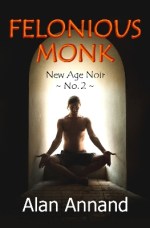 FELONIOUS MONK
Axel Crowe investigates the murder of a reporter at a Vermont ashram. His esoteric sleuthing reveals a series of Manhattan rape-murders dating back 12 years, with connections to sex trafficking, drug smuggling and the theft of an ancient golden Buddha.
“Alan Annand tells a good, gritty tale of murder, pursuit, and finally justice. The coolest thing for me is that the detective is an astrologer and a mystic. The normal sort of clue-following fun is aided and abetted by the most practical use of various divinatory arts. There’s just enough technical astrology in the pages to make it plausible and real without ever lapsing into a tutorial. That’s a hard balancing act to get right and Annand nails it.” ~ Steven Forrest
“Incredible power as a poet in prose. A page turner and a seriously magnificent piece of work.” ~ Michael Lutin
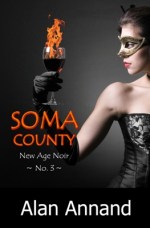
SOMA COUNTY
Axel Crowe searches for a missing person in Napa Valley and discovers a black market in body parts. When his client’s friend is also murdered, Crowe’s investigation leads from California to India and a little man with large appetites, big dogs and grand ambitions.
“Unlike anything else you can find in crime fiction, this novel portrays an investigator using an esoteric toolkit – astrology, palmistry, numerology – in a serious way that shines new light on the so-called occult arts. All of this is written in language that’s economic and evocative, terse and tension-filled, with memorable descriptions of people and places. And when the action kicks in, as it inevitably does in all of Annand’s novels, the genre shifts from mystery to thriller to full-on action where, frankly, the pages can’t quite be turned fast enough.” ~ an Amazon reviewer

PARIVARTANA YOGA
(non-fiction)
Parivartana Yogas are said to be among the most powerful of planetary combinations, having the capacity to link the effects of two astrological houses in a chart. However, aside from what we find explicitly in Mantreswara’s Phala Deepika, there’s little in the literature – neither in the many classics of Jyotisha, nor in modern books – to help us understand these yogas.
Illustrated throughout with case studies, this comprehensive reference text describes the effects for each of the 66 combinations of house lord exchange, also known as mutual receptions.
Available in digital format at all online retailers, trade paperback at Amazon.
 STELLAR ASTROLOGY
(non-fiction)
Applications in Vedic astrology: a varied collection of essays on time-tested techniques, in-depth celebrity profiles, and analysis of mundane events.
This is an educational and entertaining book for both seasoned practitioners and serious students of Jyotisha.
Available in digital format at all online retailers, trade paperback coming in 2017.
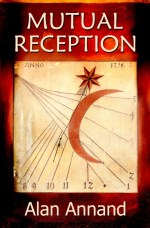 MUTUAL RECEPTION
(for western astrologers)
As a concept, mutual reception is almost 2,000 years old, yet very little has been written about it. Meanwhile, 43% of us have a mutual reception by sign in our birth chart, ie, when two planets simultaneously occupy each other’s sign.
It’s a powerful combination linking the effects of two houses in a chart, yet one of the least understood patterns in astrology. This book, an invaluable reference for any astrologer’s library, describes the effects for each of the 66 combinations of house lord exchange.
A number of techniques make it clear how to analyse the strength of each mutual reception, identify the control planet and the affected areas of life, and determine the outcome.
Available in digital format at all online retailers, trade paperback at Amazon.
~~~
Alan Annand, astrologer and palmist, is a graduate of the American College of Vedic Astrology and the British Faculty of Astrological Studies. He is the author of several books, both fiction and non-fiction.
 His NEW AGE NOIR crime novels feature astrologer and palmist Axel Crowe, whom one reviewer has dubbed “Sherlock Holmes with a horoscope.”
Websites: http://www.navamsa.com, http://www.sextile.com
You can find his books on Amazon, Apple, Barnes&Noble, Kobo and Smashwords.
 Roland Barthes (born 12 November 1915, died 26 March 1980) was a French literary theorist, philosopher, linguist and critic who influenced the development of schools of theory including structuralism, semiotics, social theory, anthropology and post-structuralism.
Quotes on language:
 Neil Gaiman, born 10 November 1960, is an English author who writes short stories, novels, comic books, graphic novels and films. His novels include Stardust, American Gods, Coraline, and The Graveyard Book.
Quotes on writing

Janet Fitch, born 9 November 1955, is best known for her novel, White Oleander. She is a faculty member in the Master of Professional Writing Program at the University of Southern California, where she teaches fiction.
Here are her Top 10 writing tips:
1. Write the sentence, not just the story
Long ago I got a rejection from the editor of the Santa Monica Review, who said: “Good enough story, but what’s unique about your sentences?” That was the best advice I ever got. Learn to look at your sentences, play with them, make sure there’s music, lots of edges and corners to the sounds. Read your work aloud. Read poetry aloud and try to heighten in every way your sensitivity to the sound and rhythm and shape of sentences. The music of words. I like Dylan Thomas best for this–the Ballad of the Long-Legged Bait. I also like Sexton, Eliot, and Brodsky for the poets, and Durrell and Les Plesko for prose. A terrific exercise is to take a paragraph of someone’s writing who has a really strong style, and using their structure, substitute your own words for theirs, and see how they achieved their effects.
2. Pick a better verb
Most people use twenty verbs to describe everything from a run in their stocking to the explosion of an atomic bomb. You know the ones: Was, did, had, made, went, looked… One-size-fits-all looks like crap on anyone. Sew yourself a custom made suit. Pick a better verb. Challenge all those verbs to really lift some weight for you.
3. Kill the cliché
When you’re writing, anything you’ve ever heard or read before is a cliché. They can be combinations of words: Cold sweat. Fire-engine red, or phrases: on the same page, level playing field, or metaphors: big as a house. So quiet you could hear a pin drop. Sometimes things themselves are clichés: fuzzy dice, pink flamingo lawn ornaments, long blonde hair. Just keep asking yourself, “Honestly, have I ever seen this before?” Even if Shakespeare wrote it, or Virginia Woolf, it’s a cliché. You’re a writer and you have to invent it from scratch, all by yourself. That’s why writing is a lot of work, and demands unflinching honesty.
4. Variety is the key
Most people write the same sentence over and over again. The same number of words–say, 8-10, or 10-12. The same sentence structure. Try to become stretchy–if you generally write 8 words, throw a 20 word sentence in there, and a few three-word shorties. If you’re generally a 20 word writer, make sure you throw in some threes, fivers and sevens, just to keep the reader from going crosseyed.
5. Explore sentences using dependent clauses
A dependent clause (a sentence fragment set off by commas, dontcha know) helps you explore your story by moving you deeper into the sentence. It allows you to stop and think harder about what you’ve already written. Often the story you’re looking for is inside the sentence. The dependent clause helps you uncover it.
6. Use the landscape
Always tell us where we are. And don’t just tell us where something is, make it pay off. Use description of landscape to help you establish the emotional tone of the scene. Keep notes of how other authors establish mood and foreshadow events by describing the world around the character. Look at the openings of Fitzgerald stories, and Graham Greene, they’re great at this.
7. Smarten up your protagonist
Your protagonist is your reader’s portal into the story. The more observant he or she can be, the more vivid will be the world you’re creating. They don’t have to be super-educated, they just have to be mentally active. Keep them looking, thinking, wondering, remembering.
8. Learn to write dialogue
This involves more than I can discuss here, but do it. Read the writers of great prose dialogue–people like Robert Stone and Joan Didion. Compression, saying as little as possible, making everything carry much more than is actually said. Conflict. Dialogue as part of an ongoing world, not just voices in a dark room. Never say the obvious. Skip the meet and greet.
9. Write in scenes
What is a scene? a) A scene starts and ends in one place at one time (the Aristotelian unities of time and place–this stuff goes waaaayyyy back). b) A scene starts in one place emotionally and ends in another place emotionally. Starts angry, ends embarrassed. Starts lovestruck, ends disgusted. c) Something happens in a scene, whereby the character cannot go back to the way things were before. Make sure to finish a scene before you go on to the next. Make something happen.
10. Torture your protagonist
The writer is both a sadist and a masochist. We create people we love, and then we torture them. The more we love them, and the more cleverly we torture them along the lines of their greatest vulnerability and fear, the better the story. Sometimes we try to protect them from getting booboos that are too big. Don’t. This is your protagonist, not your kid.

pinterest.com/pin/39406565465113267/
Kazuo Ishiguro, born 8 November 1954, is a Japanese-born British novelist. He’s one of the most celebrated contemporary fiction authors in the English-speaking world. He’s been nominated for the Man Booker Prize four times, and won in 1989 for The Remains of the Day.
Quotes on writing

Yiyun Li, born 4 November 1972, is a Chinese American writer whose works include the short story collections A Thousand Years of Good Prayers, Gold Boy, Emerald Girl, and the novel The Vagrants.
Quotes on writing:

pinterest.com/pin/39406565465077378/
Lee Smith, born 1 November 1944, is an American fiction author whose writing has won the O. Henry Award and the American Academy of Arts and Letters Award for Fiction.
Quotes on writing:


 Sextile