Archive | Literary marketplace RSS feed for this section

Peter Robinson (b. Mar 17): “Writers have to be able to enjoy solitude…”

17 Mar
robinson

pinterest.com/pin/39406565465847373/

Peter Robinson, born 17 March 1950, is a Canadian crime writer born in Britain. He is best known for his crime novels set in Yorkshire featuring Inspector Alan Banks. He has written 25 books.

Writing quotes:

  1. I think writers have to be able to enjoy solitude rather than just endure it. I’ve always enjoyed being left alone with my imagination, ever since I was a kid.
  2. Put your bum on the chair and your fingers on the keyboard. Read widely, too. When my students fail it’s usually nothing to do with lack of talent but everything to do with lack of application. So many people want to be writers, but few actually want to write!
  3. I used to write my own versions of famous tales, such as William Tell or Robin Hood, and illustrate them myself, too. When I entered my teens, I got more into horror and science fiction and wrote a lot of short stories. A literary education complicated things and for many years I wrote nothing but poetry. Then I got back to story-telling.
  4. I like newspaper stories that are incomplete, that give me room to imagine the rest. It’s no good to me reading about something that’s all neatly solved and wrapped up. That’s why so many of my stories revolve around human psychology, around why someone commits a certain crime, or series of crimes. I don’t profess to know the answers but I like to explore the possibilities.


Alice Hoffman (b. Mar 16): “Books may well be the only true magic.”

16 Mar
hoffman

pinterest.com/pin/39406565465842605/

Alice Hoffman, born 16 March 1952, is an American novelist best known for her novel Practical Magic, which was adapted for a film of the same name. Many of her works fall into the genre of magic realism.

Quotes on writing:

  1. Books may well be the only true magic.
  2. No one knows how to write a novel until it’s been written.
  3. You can’t dispute the ridiculous. You can’t argue reasonably with evil.
  4. I think love is a huge factor in fiction and in real life. Is there a risk? Always. In fiction and in life.
  5. That is the joy of reading fiction: when all is said and done, the novel belongs to the reader and his or her imagination.
  6. After a while, the characters I’m writing begin to feel real to me. That’s when I know I’m heading in the right direction.
  7. I’ve been a screenwriter for twenty-five years. Every one of my books have been optioned for movies and I have written a few of those screenplays.
  8. All the characters in my books are imagined, but all have a bit of who I am in them – much like the characters in your dreams are all formed by who you are.
  9. The original fairy tale was about the youngest sister going into a room in the castle and finding all the bodies of the wives that came before her – she is confronted with truth, thinking about how often we think we know people and we really don’t.
  10. My theory is that everyone, at one time or another, has been at the fringe of society in some way: an outcast in high school, a stranger in a foreign country, the best at something, the worst at something, the one who’s different. Being an outsider is the one thing we all have in common.


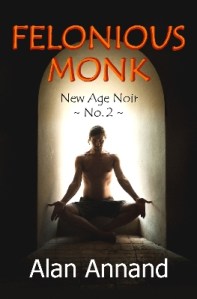
FELONIOUS MONK: the Dell Horoscope book review

5 Mar

FM ebook thumb

This book review, written by Chris Lorenz, appears in the April 2015 issue of Dell Horoscope.

~~~~~~~~~

A freelance reporter for The Village Voice gets into trouble when he follows an ex-CIA agent to a spiritual retreat in Vermont. One afternoon he confronts the former agent, accusing him of smuggling stolen foreign antiquities. That night, the reporter is murdered. The ashram manager is accused of the crime but fortunately his friend, astrologer Axel Crowe, believes in his inno­cence and sets out to find the real culprit.

The drama thus unfolds in Felonious Monk, the second of Alan Annand’s “New Age Noir” series. Annand’s hero is not only adept at astrology, but also understands how to use synchronicity to his advantage. He can read palms from a distance and, as a former student of “Guruji”, his thoughts and actions are guided by ancient wisdom. Guruji has also taught him some martial arts, which Crowe has several occasions to use over the course of the story. But this New Age hero also has modern tools to assist him. Want to know who killed the reporter? There’s an app for that.

At 6:05 AM, Crowe opens the astrol­ogy app on his cell phone and asks the question, “Whodunnit?” Now for those who enjoy some good crime fiction, Felonious Monk fits the bill. The book is written almost entirely from the sleuth’s point of view as he works day and night in the shadowy underworld, fighting off surprise attacks and uncov­ering key clues, much like Sam Spade or Mike Hammer. And for the reader who appreciates a touch of mysticism, Felonious Monk also satisfies, especially with the attention given to Eastern religion, the good and bad karma, and the periodic sage quotes from Guruji.
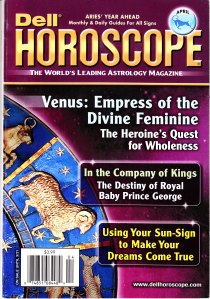
Dell Horoscope April 2015Those with various astrology back­grounds may be stumped by the kind of astrology used in Felonious Monk. Crowe uses the Vedic horoscope, which does not include the outer planets Uranus, Neptune, and Pluto, yet he also frequently uses horary principles. This detective arrives at magical deductions from the horary question, “Whodunnit?” but then horary astrology does seem quite magical in the hands of an experi­enced practitioner.

We’re introduced to Crowe’s apparent superpowers in chapter two. He’s giving a lecture on the ancient roots of astrology in India. During the Q&A session a skeptical professor asks, “Can you tell me how many kids I have?” After some snappy exchanges about the merits of the question, Crowe finally states, “You have three children. Boy-girl-boy in that order.” Astonishingly, he’s correct, and the profes­sor shamefully exits. Afterwards, we find out the secret of how Crowe knew the answer. Three questions were asked before the professor’s question, and they were asked by a man, a woman, and another man. The New Age detective connected the dots between the previous three questions and the professor’s children.

Does that actually work in the real world? The narrative is filled with the protagonist’s internal dialogue reminding readers that everything is connected to everything else. His classic film-noir antag­onism with the police is partially shaped by his astrological portrait of the killer, since he can’t tell the police his knowledge is based on a horary question. In the end, he defeats the killer and locates the missing Buddha statue with another horary ques­tion. This is not a spoiler, since we know the killer’s bad karma will eventually catch up with him.

It’s the journey through the pages of this book that is the most rewarding, enjoyable, and sometimes frightening. Crowe’s search takes him to Thailand, where he meets several fascinating characters. We see the culture’s poverty and how it makes some of its people immoral and treacherous. And we see the spiritu­al side of Thailand, its ancient temples and spiritual vistas. Crowe gets little sleep during his jaunts, but he apparent­ly regenerates himself through yoga and meditation. Are Crowe’s amazing abili­ties unique to him, or are they available to anyone who has the right teacher and a good understanding of astrology? Let me know when you find out.

~~~~~~~~~
 

???????????????????????????????Alan Annand is a Canadian astrologer and palmist with an education spanning both eastern and western astrology. He has diplomas from the American College of Vedic Astrology, as well as the British Faculty of Astrological Studies for whom he was their North American correspondence tutor for several years.

He is also a writer of crime fiction, including his NEW AGE NOIR series (Scorpio RisingFelonious MonkSoma County) featuring astrologer and palmist Axel Crowe, whom one reviewer has dubbed “Sherlock Holmes with a horoscope.”

Websites: www.navamsa.com, www.sextile.com

Read the highlighted reviews of Scorpio Rising on Pinterest.

Buy Annand’s New Age Noir series and other crime fiction on Amazon, Apple, Barnes&Noble, Flipkart, Kobo and Smashwords.

~~~~~~~~~

Khaled Hosseini (b. Mar 4th): “Literary fiction is kept alive by women…”

4 Mar

Los Angeles Premiere of "The Kite Runner"

“Literary fiction is kept alive by women. Women read more fiction, period.”  

~ Khaled Hosseini, b. 4 March 1965

http://www.pinterest.com/pin/39406565463767903/


Victor Hugo (b. Feb 26): “Sorrow is a fruit…”

26 Feb

Hugo

“Sorrow is a fruit. God does not make it grow on limbs too weak to bear it.”   

~ Victor Hugo, b. 26 February 1802

 http://www.pinterest.com/pin/39406565463732504/


Elizabeth George (b. Feb 26): “I have to know the killer…”

26 Feb
george

pinterest.com/pin/39406565465739058/

Elizabeth George, born 26 February 1949, is an American author of mystery novels set in Great Britain. 11 of her novels have been adapted for television by the BBC as The Inspector Lynley Mysteries.

Quotes on writing:

  1. It is the job of the novelist to touch the reader.
  2. I wish that I’d known back then that a mastery of process would lead to a product. Then I probably wouldn’t have found it so frightening to write.
  3. I find it both fascinating and disconcerting when I discover yet another person who believes that writing can’t be taught. Frankly, I don’t understand this point of view.
  4. I have to know the killer, the victim and the motive when I begin. Then I start to create the characters and see how the novel takes shape based on what these people are like.
  5. Essentially and most simply put, plot is what the characters do to deal with the situation they’re in. It’s a logical sequence of events that grow from an initial incident that alters the status quo of the characters.
  6. Plotting is difficult for me, and always has been. I do that before I actually start writing, but I always do characters, and the arc of the story, first… You can’t do anything without a story arc. Where is it going to begin, where will it end.
  7. Lots of people want to have written; they don’t want to write. In other words, they want to see their name on the front cover of a book and their grinning picture on the back. But this is what comes at the end of a job, not at the beginning.

Richard North Patterson (b. Feb 22): “There’s a wonderful freedom to being a novelist.”

22 Feb
patterson_RN

pinterest.com/pin/39406565465714932/

Richard North Patterson, born 22 February 1947, is an American best-selling fiction writer of 22 novels. Before he wrote full time, he studied creative writing at the University of Alabama. He was also a lawyer. He served as Ohio’s Assistant Attorney General, a Watergate prosecutor, and as an attorney for the Securities and Exchange Commission. His first novel, The Lasko Tangent, won an Edgar Allen Poe Award in 1979.

10 quotes on writing:

  1. The business of writing is empathising with situations that aren’t your own.
  2. Writing seems like the only job where what you think and feel really matters.
  3. I was 29 when I wrote my first novel. But I was 45 when I quit for good. I was a 16-year overnight success.
  4. There is a wonderful freedom to being a novelist – it’s self-assigned work. For someone who’s curious by nature, it’s a perfect job.
  5. The manuscript you submit [should not] contain any flaws that you can identify – it is up to the writer to do the work, rather than counting on some stranger in Manhattan to do it for him.
  6. Writing is re-writing. A writer must learn to deepen characters, trim writing, intensify scenes. To fall in love with the first draft where one cannot change it is to greatly enhance the prospect of never publishing.
  7. Trial lawyers have to be story tellers. They have to arrange complex facts in attractive narratives; grasp character; understand judges, juries, make clients appealing, understandable. They do have a lot of stories to tell – vivid and interesting things to talk about.
  8. Write what you care about and understand. Writers should never try to outguess the marketplace in search of a saleable idea; the simple truth is that all good books will eventually find a publisher if the writer tries hard enough, and a central secret to writing a good book is to write one that people like you will enjoy.
  9. Monday through Friday, I get up at five, read The New York Times and begin writing by seven. I work with an outline of the chapter or scenes from each day and typically finish with original writing by noon. Throughout the afternoon my assistant and I work the draft over until it’s as good as it can be. Typically we’re not happy until late afternoon.
  10. The writer must always leave room for the characters to grow and change. If you move your characters from plot point to plot point, like painting by the numbers, they often remain stick figures. They will never take on a life of their own. The most exciting thing is when you find a character doing something surprising or unplanned. Like a character saying to me: “Hey, Richard, you may think I work for you, but I don’t. I’m my own person.”


Chuck Palahniuk (b. Feb 21): “We must never, ever be boring.”

21 Feb
palahniuk

pinterest.com/pin/39406565465711796/

Chuck Palahniuk, born 21 February 1962, is an American novelist who describes his work as ‘transgressional fiction’. He is best known as the author of the award-winning novel Fight Club, which also was made into a feature film. 

Quotes on Life & Writing:

  1. All God does is watch us and kill us when we get boring. We must never, ever be boring.
  2. It’s easy to attack and destroy an act of creation. It’s a lot more difficult to perform one.creation, 
  3. You have a choice. Live or die. Every breath is a choice. Every minute is a choice. To be or not to be. 
  4. I try to tell a story the way someone would tell you a story in a bar, with the same kind of timing and pacing. 
  5. Every time I write something, I think, this is the most offensive thing I will ever write. But no. I always surprise myself. 
  6. I write compulsively. I’ve got so many ideas, and I love to do it so much, I can’t not do it. I write the way some people do drugs.
  7. What I’m always trying to do with every book is to recreate the effect of the stories we heard as children in front of camp fires and fireplaces – the ghost stories that engaged us. 
  8. Your handwriting. The way you walk. Which china pattern you choose. It’s all giving you away. Everything you do shows your hand. Everything is a self-portrait. Everything is a diary.
  9. You hear the best stories from ordinary people. That sense of immediacy is more real to me than a lot of writerly, literary-type crafted stories. I want that immediacy when I read a novel. 
  10. I always thought I’d write when I retired – when I turned 65. But by the time I was 33, to tell you the truth, I was a little bored with drugs and sex, and I thought I’d do the writing thing.
  11. I wanted to write about the moment when your addictions no longer hide the truth from you. When your whole life breaks down. That’s the moment when you have to somehow choose what your life is going to be about. 
  12. The first step — especially for young people with energy and drive and talent, but not money — the first step to controlling your world is to control your culture. To model and demonstrate the kind of world you demand to live in. To write the books. Make the music. Shoot the films. Paint the art.

Anais Nin (b. Feb 21): “If you don’t cry out or sing, then don’t write.”

21 Feb

nin3

“If you do not breathe through writing, if you do not cry out in writing, or sing in writing, then don’t write, because our culture has no use for it.”

~ Anais Nin, b. 21 February 1903


Jay McInerney (b. Jan 13): “There aren’t many shy writers left.”

13 Jan

mcinerney

“There aren’t many shy writers left.”

~ Jay McInerney, b. 13 January 1955

http://www.pinterest.com/pin/39406565463448961/